QuantiFERON Transport: One Test, Two Opposite Rules
November 12, 2026 · By LabPath Logistics Editorial Team, Medical Logistics Desk
Quick Answer
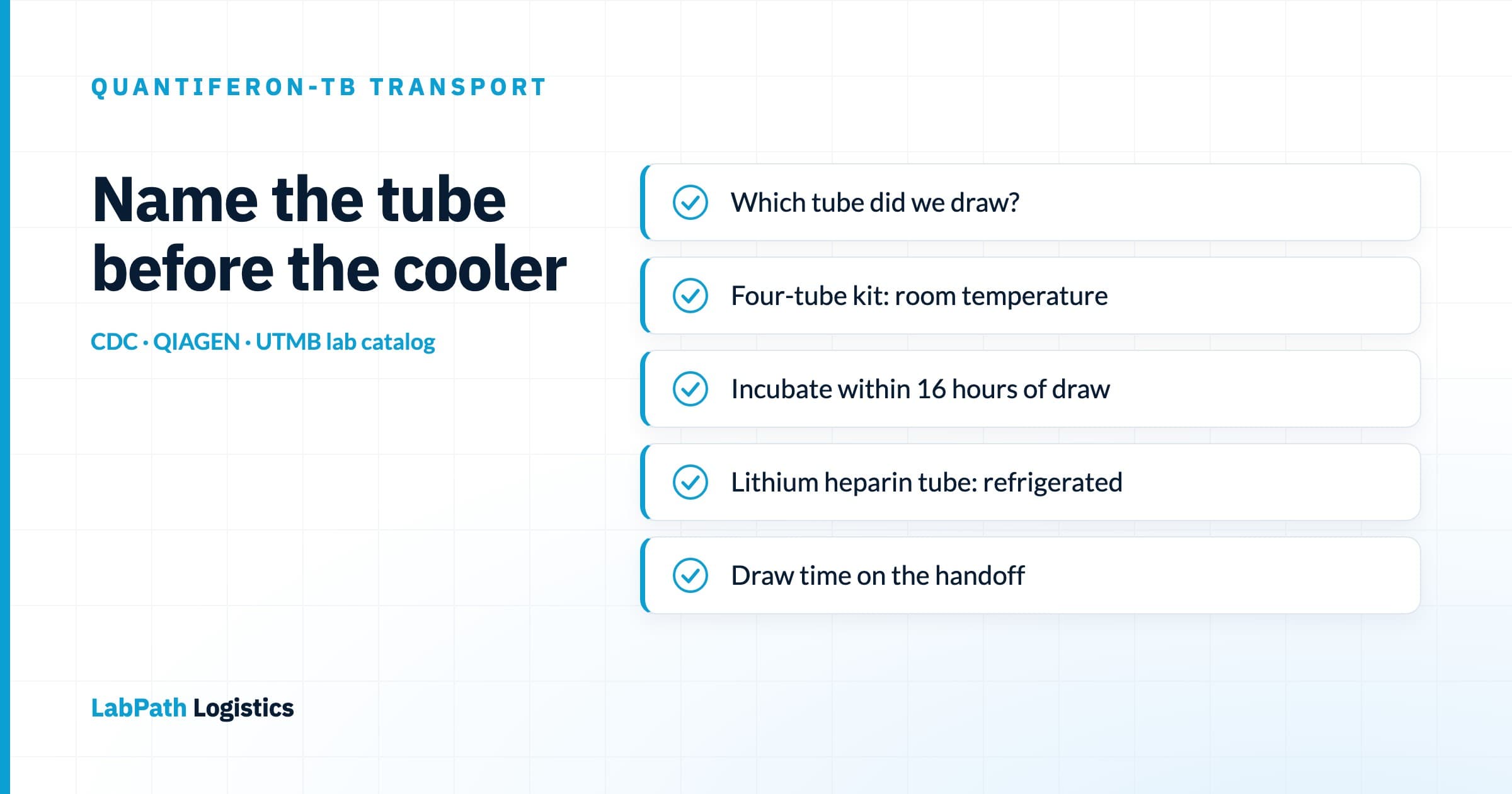
QuantiFERON-TB Gold Plus has two collection paths with opposite transport rules. The four-tube kit stays at room temperature and must be incubated within 16 hours of the draw. A single lithium heparin tube is refrigerated instead, on a longer clock the lab sets. Identify the tube first, then follow the performing lab's catalog entry.
Putting a QuantiFERON specimen in the cold cooler is either exactly right or grounds for rejection. Both are true, for the same test, on the same day. Which one applies depends on a detail most pickup instructions never mention: which tube the blood was drawn into.
This guide covers QuantiFERON specimen transport in Houston from the logistics side: the two collection paths, the clock each one starts, and how to brief a courier so nobody guesses. It is not clinical guidance. Your performing laboratory's test catalog sets the actual requirements.
How Should QuantiFERON-TB Specimens Be Transported?
It depends on the tube. The four-tube QuantiFERON kit is held at room temperature and has to reach a 37 °C incubator within 16 hours of the draw. A single lithium heparin tube, where the lab accepts one, is refrigerated and runs on a longer clock that the lab defines. Name the tube first; then the temperature and the deadline follow.
16 hours
CDC's clinical testing guidance lists the QFT-Plus processing window as within 16 hours of collection (whole blood), and tells providers to arrange delivery within the time the laboratory specifies. Source: CDC, Clinical Testing Guidance for Tuberculosis: Interferon Gamma Release Assay.
Why Does One Test Have Two Opposite Temperature Rules?
QuantiFERON measures a response from living white cells, so the blood has to stay viable until it is incubated. The manufacturer supports two ways to get there. QIAGEN's product page describes direct draw into the QFT-Plus tubes, held at room temperature for up to 16 hours before incubation, and a lithium heparin option that can be refrigerated at 2 to 8 °C before the lab transfers the blood into the QFT-Plus tubes.
- Path A, the four-tube kit: four small tubes (nil, TB1, TB2, mitogen). Room temperature only. Sixteen hours from draw to incubator.
- Path B, one lithium heparin tube: a single green-top tube. Refrigerated, with a short room-temperature allowance and a longer total window set by the lab.
The same cooler that protects Path B can ruin Path A. The University of Iowa's State Hygienic Laboratory tells submitters of the kit tubes to ship at room temperature and not refrigerate or freeze, and lists specimens received refrigerated before centrifugation among its rejection reasons.
Whose Time Limit Wins: the Manufacturer's or the Lab's?
The lab's. The manufacturer publishes outer limits; each laboratory validates its own, and they are often tighter. QIAGEN's page says a lithium heparin tube may be held at room temperature for up to 12 hours before transfer. The UTMB laboratory catalog entry in Galveston gives that same tube 3 hours at room temperature, then requires refrigerated receipt within 48 hours of collection.
3 hours
UTMB's QuantiFERON-TB Gold Plus catalog entry says a lithium heparin tube must not remain at room temperature for more than 3 hours after collection and must be received refrigerated within 48 hours. QIAGEN's own page allows up to 12 hours at room temperature. Sources: UTMB Laboratory Survival Guide; QIAGEN.
A courier instruction written from the package insert would pass the manufacturer's limit and still fail that lab's. This is the same pattern we covered in our specimen transport temperature guide: the catalog entry for the lab that performs the test is the document that counts.
What Is the Which-Tube Check?
The Which-Tube Check: save this and send it to your lab director
Five lines for the draw station. 1) Which tube are we drawing: the four-tube kit or one lithium heparin tube? Confirm the lab accepts it. 2) Four-tube kit: keep at room temperature, never in the cold cooler, and write the draw time on the handoff. 3) Count back from the lab's incubation deadline, usually 16 hours from draw, and confirm today's pickup lands inside it with margin. 4) Lithium heparin tube: refrigerate within the lab's room-temperature limit and confirm the refrigerated receipt deadline. 5) Tell the courier in writing which path is in the bag, the transport temperature, and the latest acceptable lab arrival time.
Line five matters most. "QuantiFERON pickup" tells a driver nothing about temperature. "Four QFT kit tubes, room temperature, drawn 2:15 p.m., lab receipt by 6:00 p.m." tells them everything.
How Does the 16-Hour Clock Shape a Pickup Schedule?
Sixteen hours sounds generous until you count what happens inside it. The clock starts at the draw, not the pickup. It ends when the tubes enter the incubator, not when they reach the dock. Some labs cut it shorter: Iowa's state lab asks that non-incubated tubes arrive the same day as collection, by 5 p.m. on weekdays.
There is a third option for sites with the equipment. The University of Washington's catalog entry notes that after on-site incubation, tubes are stable for up to 3 days at ambient temperature, which removes the same-day rush. That takes a 37 °C incubator and a written procedure, so it is a lab-director decision, not a courier one.
A Houston Scenario: Friday Afternoon New-Hire Screening
A Houston-area occupational health clinic runs new-hire screening in batches, and the largest batch lands Friday after lunch. Staff draw four-tube kits until 4:30 p.m. The standing lab pickup left at 3:00. The tubes drawn after that sit until Monday, or someone puts them in the specimen fridge "to be safe." Either way, the kit tubes are past their window or refrigerated, and the clinic is calling people back for redraws.
There are three honest fixes, and none is exotic. Move the screening block earlier so every draw clears the existing pickup. Add a late Friday run timed to the lab's receiving cutoff. Or ask the lab whether a refrigerated lithium heparin tube is acceptable for late-day draws. If the pickup time is the constraint, our pickup schedule guide and after-hours courier guide walk through the trade-offs.
What Should You Ask a Courier About QuantiFERON Pickups?
- Can room-temperature tubes ride fully separated from cold packs? Kit tubes pressed against a frozen pack are a rejection waiting to happen.
- Will the handoff record show pickup and delivery times, so the lab can check them against the draw time? See our proof of delivery guide.
- What is the latest pickup that still reaches the lab before its receiving cutoff, in real Houston afternoon traffic?
- Can a late run be added on screening days without rebuilding the whole route? Compare a one-off run against a scheduled stop in the estimator.
- If respiratory TB specimens also leave the site, are they packaged and handled separately? Our TB and AFB specimen guide covers that path.
LabPath Logistics is in early access for Greater Houston. Our locally verified workflow covers package-QR scans, append-only custody events, and receiver attestation, with no patient fields in the booking model, by design. Temperature-device telemetry and live tracking are not live yet, and we make no fixed-minute pickup promise. You can review planned service levels or price a late-day run in the nonbinding estimator.
Frequently Asked Questions
Should QuantiFERON tubes be refrigerated during transport?
It depends on the tube. The four-tube QuantiFERON kit is kept at room temperature, and some labs reject kit tubes that arrive refrigerated. A single lithium heparin tube, where the lab accepts it, is transported refrigerated. Check the performing lab's catalog entry for the tube you drew.
How long do you have to get QuantiFERON tubes to the lab?
For the four-tube kit, CDC lists processing within 16 hours of collection, and the clock ends at incubation, not delivery. Some labs want same-day arrival. Refrigerated lithium heparin tubes run on a longer window the lab sets; UTMB's catalog requires receipt within 48 hours.
Why was my QuantiFERON specimen rejected?
Common logistics causes listed in lab catalogs include incubation starting more than 16 hours after collection, kit tubes received refrigerated or frozen, a lithium heparin tube left at room temperature too long, and under- or over-filled tubes. Ask the lab which reason applied.
Can a clinic incubate QuantiFERON tubes on site before pickup?
Some labs allow it. The University of Washington and University of Iowa catalogs describe incubating at 37 °C for 16 to 24 hours, after which tubes are stable about 3 days at room temperature. It requires an incubator and a written procedure, so confirm with your lab director first.