Point-of-Care Testing vs. Courier: Houston Clinics
August 29, 2026 · By LabPath Logistics Editorial Team, Medical Logistics Desk
Quick Answer
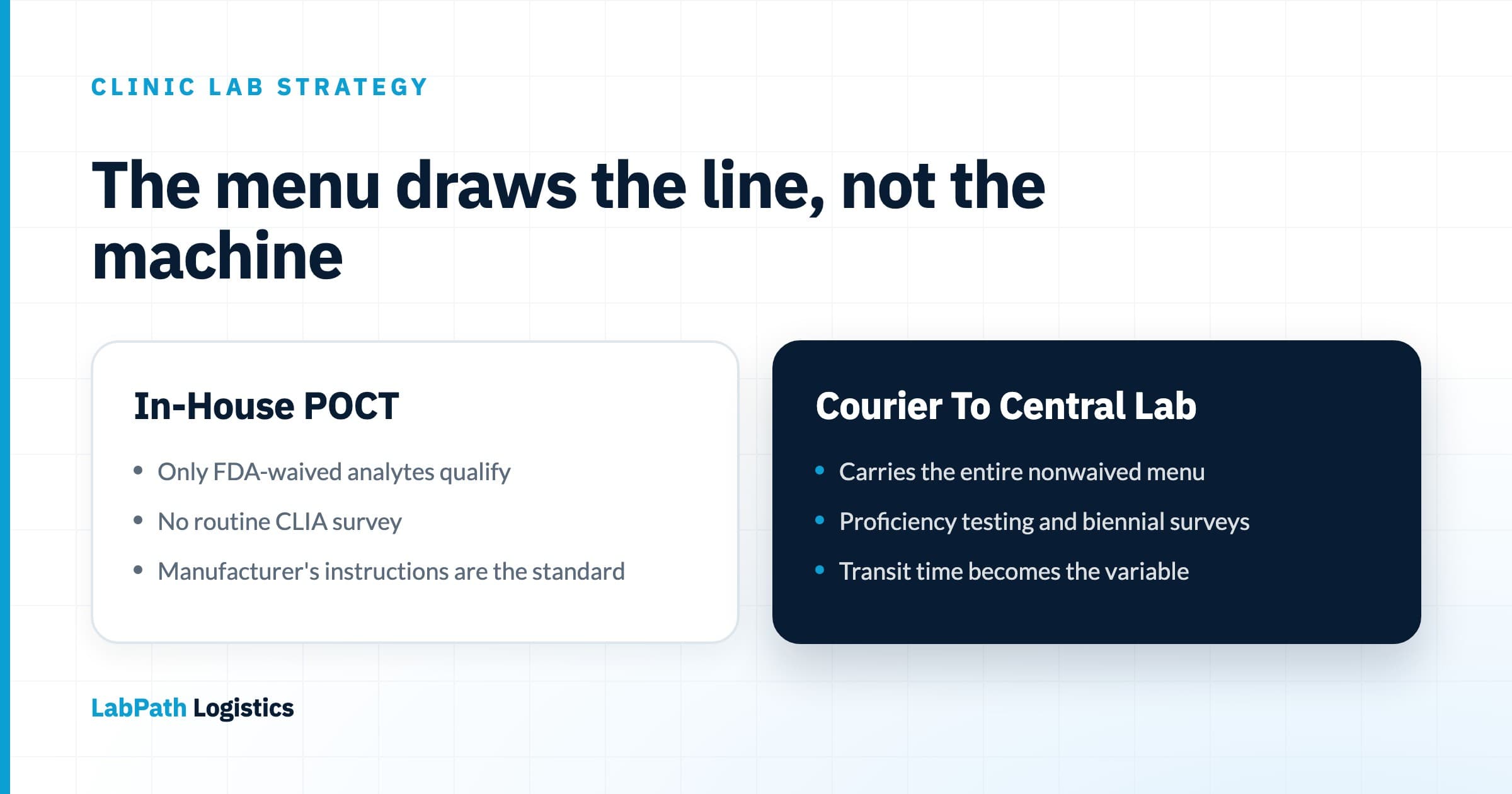
Point-of-care testing and a courier to a central lab are not competing strategies — they split along a line the FDA draws, not one your vendor draws. A clinic can run a test in-house on a CLIA Certificate of Waiver only if the specific test system is FDA-waived for that analyte; the FDA's Currently Waived Analytes database lists 155 such analytes, and 42 CFR 493.15(e) requires waiver-only laboratories to follow the manufacturer's instructions exactly. Every test outside that list is nonwaived, which pulls the clinic into proficiency testing, personnel qualifications, and biennial CLIA surveys — which is why most clinics keep a short in-house menu and move everything else on a courier run.
Point-of-care testing vs. courier to a central lab is usually argued as a speed question, and that framing is what gets Houston clinics into trouble. Speed is the easy part — a rapid analyzer on the counter obviously beats a van. The hard part is that the decision is not actually yours to make test by test. A federal list decides which tests you are allowed to run under the certificate you already hold, and stepping over that line changes your clinic's regulatory category, not just its workflow.
The useful version of this decision is narrow: figure out which of your ordered tests are FDA-waived, run those in-house if the volume justifies the instrument, and design a courier schedule around everything left over. That leftover is almost always larger than clinic managers expect.
The FDA Draws the Line, Not Your Vendor
CLIA applies to essentially every clinic that touches a specimen. The CMS brochure How to obtain a CLIA Certificate states that CLIA "generally requires all facilities that perform even one applicable test, including waived tests" on materials derived from the human body to meet federal requirements. There is no small-clinic exemption and no Texas carve-out — CMS lists Washington and New York as the only states operating their own approved laboratory programs.
What your certificate permits is set by complexity. A Certificate of Waiver covers only tests the FDA has categorized as waived, and that list is finite and public: the FDA's CLIA Currently Waived Analytes database enumerated 155 analytes when we checked it in August 2026. Glucose, HbA1c, urine dipstick, influenza A/B, group A strep, HIV antibody, prothrombin time, urine hCG, and a long tail of drug-screen analytes are on it. Most of a primary-care or specialty clinic's order volume is not.
155
Analytes listed in the FDA's CLIA Currently Waived Analytes database as of August 2026. A test system must be waived for the specific analyte — a waived instrument does not make an unlisted assay waived.
The second constraint inside a Certificate of Waiver is procedural and gets overlooked. Under 42 CFR 493.15(e), waiver-only laboratories must "follow manufacturers' instructions for performing the test." That is the entire quality system, which sounds permissive until an instrument's package insert specifies a storage temperature, a control frequency, or a specimen age limit that the clinic's actual workflow does not honor.
What Changes the Day You Add One Nonwaived Test
This is the part that turns a purchasing decision into a compliance program. CMS is explicit that the certificate you hold "should be for the highest (most complex) category of testing you perform," and that a waiver-only laboratory wanting to add provider-performed microscopy or any moderate- or high-complexity test "must reapply for the appropriate certificate" on Form CMS-116.
Crossing that line brings on obligations that a waived menu never triggers:
- Routine inspection. CMS notes that laboratories holding a Certificate of Waiver or PPM certificate "are not subject to routine surveys," while laboratories performing nonwaived testing hold a Certificate of Compliance or Accreditation and "are subject to biennial surveys."
- Proficiency testing. Under 42 CFR 493.801, each laboratory must enroll in an HHS-approved proficiency testing program "for each of the specialties and subspecialties for which it seeks certification."
- Personnel qualifications. 42 CFR 493.1423 sets education and training pathways for anyone performing moderate-complexity testing — degree pathways in a laboratory science or nursing, a qualifying military laboratory course, or a high school diploma plus documented training covering specimen collection, instrument use, quality control, and result validation.
- Directorship and supervision. Nonwaived testing requires a qualified laboratory director on the certificate, a role most clinics have to contract for rather than staff.
The instrument is the cheap part.
Analyzer capital is usually the smallest line in a nonwaived in-house program. The recurring costs are proficiency testing enrollment per specialty, documented competency assessment, quality control materials, a laboratory director arrangement, and a biennial survey you now have to pass. Price those before comparing an analyzer against a per-stop courier rate.
Texas Clinics Have Already Voted on This
The August 2026 CMS CLIA Statistics tables show what the market actually does. In Texas, 24,052 laboratories hold a Certificate of Waiver, against 936 with a Certificate of Compliance, 1,749 with a PPM certificate, and 2,527 with a Certificate of Accreditation. Roughly four in five Texas CLIA laboratories are waiver-only — meaning the overwhelming majority of Texas clinical sites run a short in-house menu and send the rest somewhere else.
24,052
Texas laboratories holding a CLIA Certificate of Waiver in August 2026, versus 936 holding a Certificate of Compliance. Source: CMS CLIA Statistics, Division of Clinical Laboratory Improvement and Quality.
The national picture is the same shape. Of 285,470 non-exempt registered laboratories, 232,736 are waiver-only, and physician offices account for 116,613 of the 300,720 registered facilities — the single largest facility type in the database. The waived-testing clinic that couriers everything else is not a compromise. It is the standard American configuration.
The Four Questions That Settle It
Run a candidate test through these in order. The first "no" ends the analysis, which is what makes this faster than a spreadsheet.
- Is this specific test system FDA-waived for this analyte? Check the FDA database by analyte, not by instrument brand. A manufacturer's platform can have waived and nonwaived configurations.
- Does the result change what happens during this visit? A waived test that gets acted on before the patient leaves earns its cost. One that gets reviewed tomorrow does not — it should have ridden a courier to a bench that runs it cheaper.
- Can we honor the package insert every single day? Storage, control runs, operator training, and specimen age limits are the compliance surface of a waived program under 493.15(e). If the answer depends on who is working that afternoon, the test belongs off-site.
- What is the confirmatory path? Screening in-house often generates a nonwaived confirmation that has to travel anyway. Count that second leg before crediting the first with a turnaround win.
A Houston Example
Take a multi-specialty clinic near the Texas Medical Center corridor evaluating whether to bring testing in-house to cut turnaround. Its top ordered items break into three groups almost immediately.
- In-house, clearly. Point-of-care glucose, HbA1c, urine dipstick, urine hCG, and rapid group A strep are waived analytes acted on during the visit. The instrument pays for itself in avoided callbacks.
- Courier, clearly. Comprehensive metabolic panels, lipid panels beyond waived configurations, thyroid studies, cultures with susceptibilities, and anatomic pathology are nonwaived. Bringing any one of them in-house converts the clinic into a Certificate of Compliance laboratory.
- The judgment calls. Rapid respiratory antigens and waived drug screens are technically in-house eligible, but each frequently generates a confirmatory order that travels regardless.
The operational consequence is that the courier schedule does not shrink much when point-of-care testing arrives — the stops still happen, they just carry a slightly different mix. That is why we size runs against the residual menu rather than against total order volume, the same arithmetic we walk through in sizing a specimen pickup schedule.
What Point-of-Care Testing Does Not Remove From the Run
Clinics that add waived testing and then trim courier coverage usually discover the same four categories still moving, on a schedule that now has fewer pickups to ride on.
- Nonwaived orders, which is most of the chemistry, hematology, microbiology, and pathology volume.
- Reflex and confirmatory testing generated by the in-house screens themselves.
- Reference and send-out testing, which has its own cutoffs and stability windows — covered in send-out testing logistics.
- Non-specimen freight: supplies, controls, requisitions, and inter-site documents that were sharing the van all along.
The turnaround gain from point-of-care testing is real but local — it applies to the tests it applies to. For everything else, turnaround is still governed by collection-to-bench transit, which we break down in what actually drives lab turnaround time.
Key Takeaway
Point-of-care testing vs. courier is not a build-versus-buy argument, because the FDA already partitioned the menu. Take the waived analytes your clinicians act on during the visit, run those in-house against the package insert, and stop there. Everything past that line — the nonwaived majority, the confirmations, the send-outs — needs a transport schedule designed for it, not a courier contract left over from before the analyzer arrived. Clinics that re-scope the courier run at the same time they buy the instrument get both benefits. Clinics that only buy the instrument end up paying for a schedule sized for a menu they no longer have.
Frequently Asked Questions
Do I need a CLIA certificate to run point-of-care tests in my clinic?
Yes. CMS states that CLIA generally requires all facilities performing even one applicable test, including waived tests, on materials derived from the human body to meet federal requirements. A clinic running only FDA-waived tests needs a Certificate of Waiver, which is obtained with Form CMS-116 through the state agency and renewed on a two-year cycle. Washington and New York are the only states operating their own CMS-approved laboratory programs, so Texas clinics enroll through CLIA directly.
Which tests can a clinic run in-house without a full laboratory?
Only tests the FDA has categorized as waived for that specific analyte and test system. The FDA's CLIA Currently Waived Analytes database listed 155 analytes as of August 2026, including glucose, hemoglobin A1c, urine dipstick parameters, urine hCG, influenza A/B, group A strep, HIV antibodies, and prothrombin time. Waiver status attaches to the analyte-and-system pair, not to the instrument brand, so a platform can have both waived and nonwaived configurations. Anything outside the list is nonwaived and requires a Certificate of Compliance or Accreditation.
What happens if my clinic adds a nonwaived test to its menu?
The clinic must reapply on Form CMS-116 for a certificate matching the highest complexity of testing it performs. That brings proficiency testing enrollment under 42 CFR 493.801 for each specialty and subspecialty, testing personnel qualification requirements under 42 CFR 493.1423 for moderate complexity, a qualified laboratory director, documented quality control, and biennial CLIA surveys — which Certificate of Waiver laboratories are not subject to. The recurring compliance cost usually exceeds the cost of the analyzer itself.
Does point-of-care testing eliminate the need for a medical courier?
No, and in most clinics it barely reduces the number of stops. Waived testing covers a short list of analytes, so the nonwaived majority — chemistry panels, hematology, microbiology, anatomic pathology — still travels to a central or reference laboratory. In-house screening also generates reflex and confirmatory orders that move off-site, and the courier run typically carries supplies, controls, and inter-site documents as well. What usually changes is the mix inside each pickup, not the schedule itself, which is why the courier schedule should be re-sized against the residual menu rather than cancelled.