Fertility Clinic Courier Houston: The 50-Minute Rule
August 22, 2026 · By LabPath Logistics Editorial Team, Medical Logistics Desk
Quick Answer
A fertility clinic courier in Houston should not be carrying fresh diagnostic semen samples. The WHO laboratory manual gives an off-site sample a hard ceiling — delivered to the laboratory preferably within 30 minutes of collection and no longer than 50 minutes — while held between 20 °C and 37 °C, which is a window a cross-town route cannot reliably meet. What does belong on a courier route is the rest of the program: same-morning cycle-monitoring draws whose results set that evening's dose, infectious-disease screening blood, and supply legs between satellite offices and the andrology lab. Cryopreserved and donor reproductive tissue is a third category again, governed by FDA human cells and tissue rules under 21 CFR Part 1271, with its own shipping conditions and tracking codes.
Fertility clinics are among the most logistics-dependent outpatient facilities in Greater Houston, and among the least well served by a generic courier contract. A single patient cycle can generate a dozen early-morning blood draws in two weeks, each one setting a medication dose that night. The same clinic may run a satellite office in Sugar Land, an andrology bench in the Texas Medical Center corridor, and a cryostorage relationship with a third address entirely. A fertility clinic courier in Houston has to know which of those legs it can carry — and which one it should refuse.
The refusal comes first because it is the one most often gotten wrong. Fresh diagnostic semen samples have a transport window measured in minutes, not hours, and no amount of route optimization moves it. Everything else in a fertility program is well within normal courier discipline, and most clinics under-use a courier precisely because they assume the hardest specimen defines the whole relationship.
The 50-Minute Rule, and Why It Is Not Negotiable
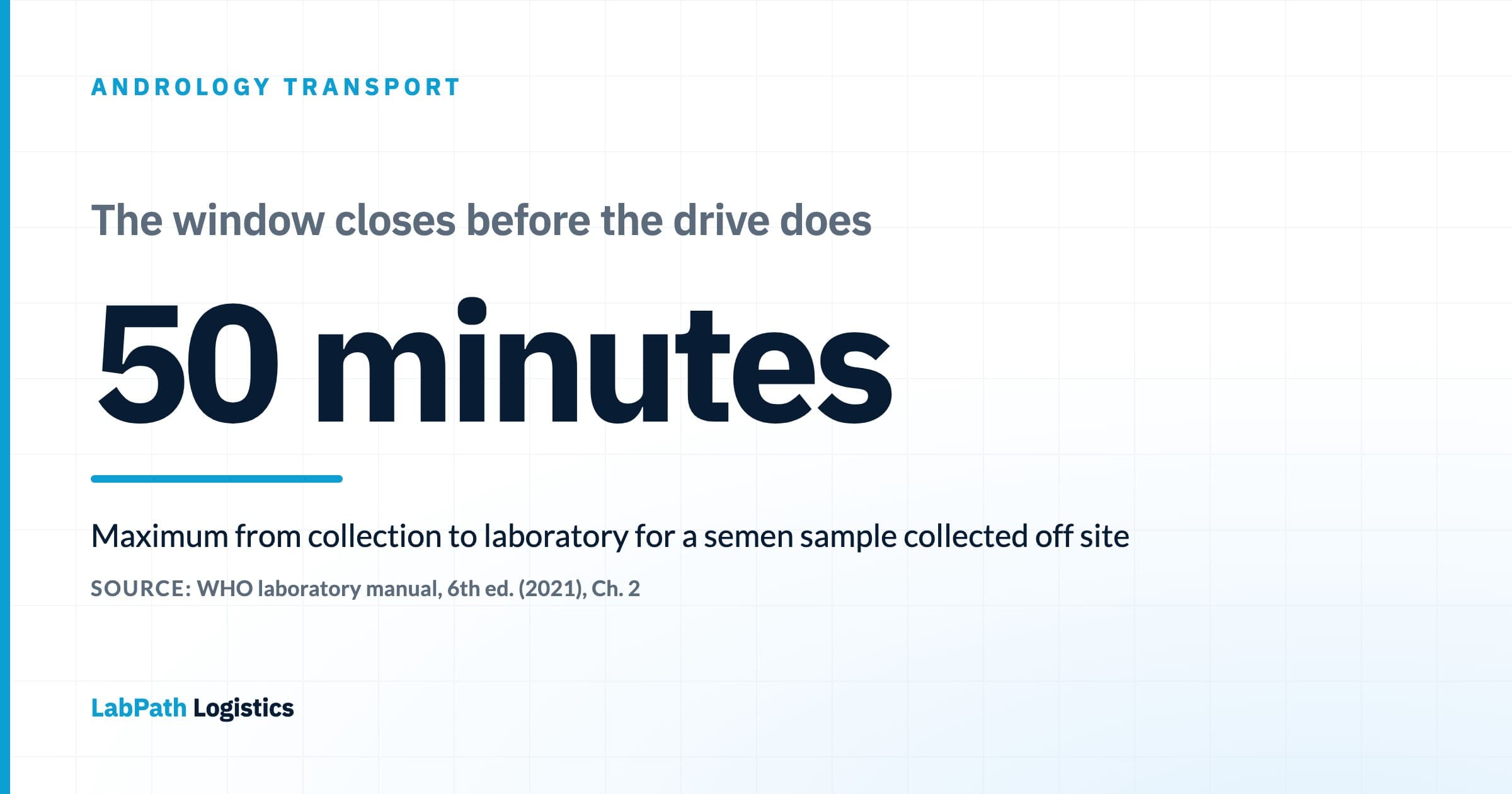
50 minutes
Outer limit from collection to laboratory delivery for a semen sample collected away from the lab, per the WHO laboratory manual, 6th edition
The governing reference for basic semen examination is the WHO laboratory manual for the examination and processing of human semen, sixth edition, published in July 2021. Its collection guidance is unusually specific about time and temperature, and the numbers are tighter than most clinic staff remember.
- Investigations should commence within 30 minutes after collection, and at least within 60 minutes.
- When the sample is collected away from the laboratory, it should be delivered preferably within 30 minutes of collection and no longer than 50 minutes.
- Transport must not allow the sample temperature to fall below 20 °C or rise above 37 °C.
- The manual's own remedy for off-site collection is body heat — the container kept close to the body, under clothing, during transport.
Read those together and the operational conclusion writes itself. A specimen whose recommended carriage method is a patient's own armpit is not a specimen that survives a routed vehicle with six other stops. Add Houston geography — a Sugar Land address to a Medical Center bench is a 45-minute drive on a cooperative morning and considerably worse at 8:00 a.m. — and the 50-minute ceiling is consumed by transit alone, before pickup, accessioning, or liquefaction.
The design answer, not the workaround
The fix is not a faster driver. It is a collection room close to the bench, or a satellite andrology capability, or scheduling patients to the site that can analyze the sample. A courier that offers to solve this with speed is selling you a result you cannot defend.
The Leg That Actually Belongs on a Route
Cycle monitoring is where a courier earns its contract at a fertility clinic. During ovarian stimulation, patients present for serial early-morning draws — estradiol, LH, progesterone, sometimes FSH — alongside ultrasound. Those results are not archival. They set the gonadotropin dose the patient will self-administer that evening, and they determine trigger timing, which is a same-day decision with no tolerance for a next-morning result.
That makes the monitoring draw a textbook courier problem: high frequency, narrow pickup window, predictable geography, and a clinical deadline downstream. It is also the leg most often left to whoever is free, which is how a 6:30 a.m. draw becomes a 1:00 p.m. accession. What a fixed pickup time plus a timestamped custody record actually produces is a defensible clock, which is what the platform records at each leg. The mechanics of protecting that window are the same mechanics we described in our guide to lab turnaround time and the courier leg — the difference is that here the deadline is a dose, not a chart note.
- Monitoring draws. Serial hormone panels with a same-morning result requirement and a fixed pickup time, not a fixed pickup window.
- Infectious disease screening blood. Routine serology tubes on a standard route, sequenced so results land before a scheduled procedure rather than after it.
- Inter-site transfers. Requisitions, collection supplies, transport media, and consent packets moving between a satellite office and the main clinic.
- Reference lab hand-offs. Genetic and specialty assays that leave Houston entirely, where the courier's job is hitting the carrier cutoff rather than carrying the sample to its destination.
None of that requires special authorization. All of it requires the specimen to stay inside a declared temperature state, which is a discipline problem rather than an equipment problem — we broke down the three transport states and how they fail in our post on specimen transport temperature.
Cryopreserved and Donor Tissue Is a Third Category
Reproductive cells and tissue held for later use are regulated as human cells, tissues, and cellular and tissue-based products — HCT/Ps — under FDA rules at 21 CFR Part 1271. That framework is not a courier convention; it is a manufacturing and tracking regime that reaches the transport leg directly.
Two provisions matter most to anyone moving these containers. First, 21 CFR §1271.265 requires that packaging and shipping containers be designed and constructed to protect the HCT/P from contamination, and that the establishment establish appropriate shipping conditions to be maintained during transit for each type of HCT/P. It also requires that a predistribution shipment travel in quarantine, with pre-established criteria documented before the container moves.
Second, 21 CFR §1271.290 requires each HCT/P to be labeled with a distinct identification code that relates it to the donor and to all records pertaining to it — and states plainly that the code may not include an individual's name, social security number, or medical record number. The tracking system exists so a suspected communicable disease transmission can be investigated from donor to consignee.
A label with no name on it
The §1271.290 code is a useful model for every specimen a courier touches, not just tissue. Identity travels as a code that resolves inside the clinical system; it does not travel as a patient name on the outside of a container. That is the same principle behind the opaque-QR custody records described on our [compliance page](/compliance) — the courier leg proves custody without carrying identity.
One nuance that reliably confuses new staff: donor screening and testing requirements do not apply to reproductive cells or tissue donated by a sexually intimate partner of the recipient for reproductive use, under 21 CFR §1271.90(a)(2). That exemption is about donor eligibility. It is not a general exemption from Part 1271, and it says nothing about how the container ships. Chain-of-identity handling for cryopreserved material is closer to the discipline we described for cell therapy transport than to a routine specimen run.
A Houston Scenario
Consider a Houston-area fertility practice with a main clinic inside the loop and a satellite in Katy. Monitoring draws happen at both sites between 6:30 and 8:00 a.m. Andrology testing runs only at the main site. Cryostorage sits with a third-party facility.
The workable design assigns each specimen to the lane its physics allow. Semen analysis appointments are booked only at the main site, because the 50-minute clock cannot absorb the Katy Freeway. Monitoring draws from both sites move on a fixed 8:15 a.m. pickup with a single mid-morning delivery, so the lab receives one batch it can run against a known deadline instead of a trickle it has to interleave. Cryostorage transfers are scheduled events with named handlers and documented shipping conditions, never appended to a routine route. The clinic gains predictability; the courier gains a route it can actually keep.
What to Specify Before You Sign
- A written scope line stating that fresh diagnostic semen samples are not tendered to or accepted on courier routes, with the WHO time and temperature limits cited as the reason.
- Fixed pickup times for monitoring draws, expressed as a clock time rather than a window, with the downstream result deadline written into the agreement.
- A declared temperature state for every specimen type on the route, and a record of what the container actually held rather than what it was supposed to hold.
- Timestamped custody transfer at both ends of every leg, with identity carried as a code rather than a patient name on the container.
- A separate, scheduled protocol for any cryopreserved or donor reproductive tissue movement, including who establishes the shipping conditions and who documents release.
- An escalation path that names a person for a missed 6:30 a.m. draw, because that is the failure with the shortest fuse in the whole program.
Key Takeaway
Fertility programs fail their courier relationship in one of two directions. They either hand over a specimen whose 50-minute window no vehicle can honor, or they use a courier for nothing at all because that one specimen made the whole idea look unworkable. Split the program into three lanes — the sample that stays with the patient, the monitoring draw that runs on a clock, and the regulated tissue that moves as a scheduled event — and each lane becomes straightforward. The clinic that writes that split into the contract stops improvising it at 6:30 in the morning.
Frequently Asked Questions
Can a medical courier transport semen samples for analysis in Houston?
For fresh diagnostic samples, practically no. The WHO laboratory manual, sixth edition, states that a sample collected away from the laboratory should be delivered preferably within 30 minutes of collection and no longer than 50 minutes, while being kept between 20 °C and 37 °C — the manual suggests carrying the container against the body under clothing. A multi-stop courier route cannot reliably meet that window across Greater Houston. Schedule semen analysis at a site with an andrology bench instead, and use the courier for the monitoring draws, screening blood, and supply legs around it.
What temperature should a semen sample be kept at during transport?
The WHO laboratory manual, sixth edition, states that transport must not allow the sample temperature to go below 20 °C or above 37 °C. Both directions matter: chilling is as damaging as overheating, which is why the manual's guidance for off-site collection is to keep the container close to the body under clothing rather than in any cooled carrier. Ambient carriage in a Houston vehicle in August sits well outside that band without active control.
How are cryopreserved embryos and reproductive tissue regulated in transport?
As human cells, tissues, and cellular and tissue-based products under 21 CFR Part 1271. Section 1271.265 requires packaging and shipping containers designed to protect the product from contamination and requires the establishment to define appropriate shipping conditions for each type of HCT/P, with predistribution shipments moving in quarantine. Section 1271.290 requires a distinct identification code linking the product to the donor and all related records, and that code may not contain a name, social security number, or medical record number.
Does a partner's sample need FDA donor screening before transport?
Under 21 CFR §1271.90(a)(2), reproductive cells or tissue donated by a sexually intimate partner of the recipient for reproductive use are exempt from the donor eligibility requirements — the screening and testing determinations. That exemption is narrow. It does not exempt the material from Part 1271 generally, and it does not change packaging, shipping-condition, or tracking obligations. Treat transport requirements and donor eligibility as two separate questions.