Urine Culture Transport in Houston: Pick the Clock First
October 18, 2026 · By LabPath Logistics Editorial Team, Medical Logistics Desk
Quick Answer
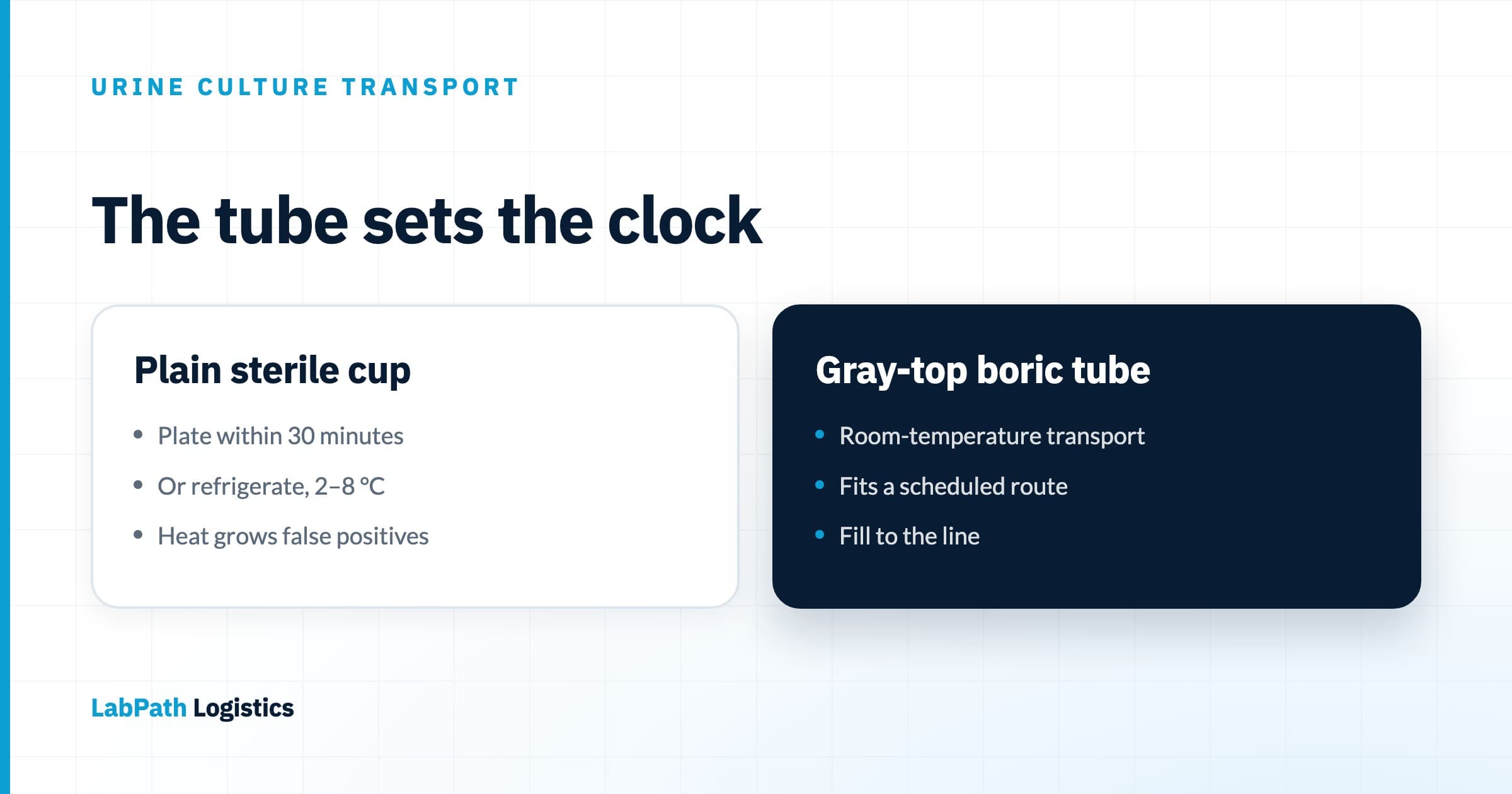
Urine culture transport depends on the container, not the courier. IDSA and ASM guidance says urine should be plated within 30 minutes unless it is refrigerated or placed in a boric acid (gray-top) preservative tube. Use gray-top tubes filled to the line or keep cups at 2 to 8 °C, then ship on a scheduled route.
A urine culture sitting in a plain cup on your counter is on a 30-minute clock. Most Houston clinics try to beat that clock with courier speed, and most lose, because no courier plates a specimen. Urine culture specimen transport is decided earlier, at the moment someone picks the container. Choose the right tube and a once-a-day scheduled route is enough. Choose the wrong one and even a STAT run arrives too late.
This guide is for urgent care, family medicine, OB-GYN, and urology practice managers who send urine cultures to a reference lab. It covers what the expert guidance actually says, how Houston heat changes the math, and a short card we call the Three-Clock Card that tells your staff which clock each specimen is on before the courier is ever called.
How Long Can a Urine Culture Wait Before Plating?
It depends entirely on how the urine is held. A 2022 review of the IDSA and ASM laboratory guidance in the Cleveland Clinic Journal of Medicine by Werneburg and Rhoads summarizes three acceptable paths: place the urine in a boric acid (gray-top) preservative tube if it travels at room temperature, refrigerate it after collection and during transport, or inoculate it within 30 minutes if it is neither refrigerated nor preserved.
30 minutes
window to inoculate a urine culture that is neither refrigerated nor preserved with boric acid, per IDSA/ASM guidance summarized by Werneburg and Rhoads (Cleveland Clinic Journal of Medicine, 2022)
Why so short? Urine is a growth medium. Bacteria that were present at collection, including contaminants from the skin, keep multiplying at room temperature, and the review names bacterial overgrowth during transport as the preanalytical problem these rules exist to prevent. A culture that overgrows in transit can report a higher count than the patient actually had.
What Are the Three Clocks for Urine Cultures?
Every urine culture leaving your clinic is on one of three clocks. The exact hours come from your performing lab's catalog, not from a blog, but the shape is consistent. One large New York health system's urine culture test entry is a typical example: it treats boric acid transport tubes as the optimal specimen, asks for at least 4 mL in the tube, and lists submission within 24 hours as optimal with up to 48 hours acceptable. Urine not in a preservative tube must travel refrigerated at 2 to 8 °C and arrive within 24 hours.
- Clock 1, the plain cup at room temperature: about 30 minutes. Only realistic if the lab is on site.
- Clock 2, the plain cup refrigerated at 2 to 8 °C: commonly 24 hours, if the cold is unbroken from the fridge to the lab bench.
- Clock 3, the gray-top boric acid tube filled to the line: commonly 24 to 48 hours at room temperature, per the lab's catalog.
4 mL
minimum urine volume transferred into a boric acid transport tube in one health system's urine culture instructions; smaller volumes go refrigerated in the original container (Northwell Health Labs test directory)
The fill line matters. A boric acid tube is designed for a set volume of urine, so an underfilled tube changes the preservative concentration. That is why labs set a minimum volume and route short samples back to the refrigerated clock.
Why Is Houston Harder on Urine Cultures?
Because Clock 2 breaks quietly. A refrigerated cup is only on the 24-hour clock while it stays cold. Put it in an exterior lockbox without cold packs, a staff car between offices, or a courier bag with no insulation, and it slides back toward Clock 1 without anyone noticing. Our Houston heat guide and lockbox guide cover how fast that happens in summer.
Gray-top tubes are the forgiving option here, because they are built for room-temperature transport. They still should not bake in a sunlit box; follow the tube manufacturer's and lab's storage limits. But a clinic that standardizes on gray-tops removes the most fragile link, the unbroken cold chain, from most of its urine volume. Our specimen transport temperature guide explains why mixing chilled and room-temperature specimens in one bag is where errors start.
The Three-Clock Card: Copy This Into Your Pickup Area
The Three-Clock Card: save and send to your lab director
(1) Default every outpatient urine culture to a gray-top boric acid tube, filled between the lines. (2) Short sample under the lab's minimum? Keep the original cup and move it to the fridge at 2 to 8 °C now. (3) Write the collection time on the requisition; the lab's clock starts there, not at pickup. (4) Refrigerated cups ride in an insulated tote with cold packs; gray-tops ride separately at room temperature. (5) Nothing waits in a sunlit lockbox or a parked car. (6) Post your performing lab's exact hours for both clocks next to the specimen fridge.
Line three is the one teams skip. A cup collected at 9 a.m. and picked up at 4 p.m. has used seven hours of its refrigerated clock before the courier arrives. If you send cultures to more than one lab, our microbiology transport guide covers how other culture types differ.
A Houston Scenario: The Urgent Care Evening Rush
An urgent care in Katy sees most of its UTI visits after 5 p.m. Its reference lab courier comes once, at 3 p.m. Evening cultures are collected in plain cups and left on the counter until the morning shift refrigerates them. By the next afternoon's pickup, some of those cups have spent hours at room temperature and nearly a full day since collection.
Adding a second courier run would not fix this. The fix is in the room: gray-top tubes stocked in every exam room, a fridge rule for short samples, and collection times on every requisition. With that in place, the existing afternoon run or a second scheduled stop can carry the evening cultures inside their window. Our urgent care courier guide covers the weekend version of the same gap, and our pickup schedule guide helps you set the run times.
Which Courier Service Level Fits Urine Cultures?
For preserved or refrigerated cultures, a scheduled route timed to your collection peaks. STAT only makes sense for the rare plain, unrefrigerated cup that truly must reach a nearby lab within minutes, and the better answer is usually to stop creating those cups. On our current public rate card, shared scheduled stops start at $38 and STAT starts at $95; both are nonbinding marketing estimates. The estimator shows how a scheduled lane prices for your address, and our services page lists the planned service levels.
What to require from the courier is separation and a record: cold totes kept apart from room-temperature bags, and pickup and handoff times logged against each order. LabPath Logistics is in early access. Our booking-to-receiver-attestation workflow, including package QR scans, append-only custody events, and receiver signature, is verified locally; production dispatch, GPS, and temperature telemetry are not live yet. The booking model has no patient fields, by design. Our platform preview shows what is verified and what is still a launch requirement.
Frequently Asked Questions
How long can a urine culture sit at room temperature?
Not long if it is in a plain cup. IDSA and ASM guidance, as summarized in the Cleveland Clinic Journal of Medicine, says urine that is neither refrigerated nor preserved with boric acid should be inoculated within 30 minutes. Boric acid preservative tubes are designed for room-temperature transport; follow your lab's stated window.
Does a urine culture need to be refrigerated during transport?
Only if it is not in a boric acid preservative tube. Unpreserved urine should be refrigerated at 2 to 8 °C after collection and during transport. Many lab catalogs then allow about 24 hours to receipt. Gray-top boric acid tubes travel at room temperature instead.
What happens if a boric acid urine tube is underfilled?
The preservative-to-urine ratio is off, which is why labs set a minimum volume. One health system's instructions require at least 4 mL in the boric acid tube and ask that smaller samples be sent refrigerated in the original sterile container instead.
Do urine cultures need STAT courier delivery?
Usually not. A properly filled boric acid tube or an unbroken refrigerated cup gives hours of transport time, so a scheduled route timed to your collection peaks is the better fit. Spend on the right tubes, cold totes, and collection-time records rather than on speed.