Texas Pharmacy Delivery Rules 2026: Courier vs Carrier
October 14, 2026 · By LabPath Logistics Editorial Team, Medical Logistics Desk
Quick Answer
Under 22 TAC §291.12, amended in August 2025, a Class A, A-S, E, or E-S pharmacy can deliver prescriptions three ways: by common or contract carrier, by its own employee or a same-day courier, or by drone. On the same-day courier path, the pharmacy owns temperature and every delivery problem until the patient has the drug.
The 2025 amendments to Texas's pharmacy delivery rule did something quieter than permit drones. They added a definition of "contract carrier" to 22 TAC §291.12, which means the company that moves your refrigerated refills across Houston now has a name in the rule. Which subsection governs a given run then turns on one phrase: same-day courier service. Texas pharmacy delivery rules in 2026 are a routing question before they are a compliance question.
This guide lays out the three delivery paths in the amended rule, what each one requires, the Eight-Line Delivery Policy you can copy from the rule's own text, a Houston scenario, and the questions to ask a courier before the agreement is signed. Our earlier discharge medication guide covered the 2024 version of the rule; this one covers what the Board changed.
What Changed in 22 TAC §291.12 in 2025?
The Texas State Board of Pharmacy proposed amendments to §291.9 and §291.12 in early 2025, sent them back for a second round of comment in May, and adopted them at its August 2025 meeting. The Board's August 21, 2025 rule memo describes the §291.12 amendments as allowing and specifying requirements for delivery by contract carriers and unmanned aircraft systems. The current text is in the Board's compiled rules, dated September 1, 2026.
Three things changed. The rule now defines a common carrier, which holds itself out to the public, and a contract carrier, which transports property for industrial customers under a bilateral agreement. It adds a drone subsection with its own packaging, policy, custody, and security requirements. And it collects the duties that apply to every delivery, whatever the method, into one closing subsection. One detail worth knowing: the March 2025 draft excluded drugs requiring storage below a "cool" temperature from drone delivery, and the adopted text dropped that exclusion. Only controlled substances and sterile compounded preparations remain off the drone.
3
delivery paths in the amended rule: common or contract carrier, pharmacy employee or same-day courier, and unmanned aircraft system (22 TAC §291.12(c), (d), and (e), Texas State Board of Pharmacy rules compiled Sept. 1, 2026)
Which Delivery Path Is Your Pharmacy On?
Call it the Three-Path Map. Every prescription that leaves a Class A, A-S, E, or E-S pharmacy by someone other than the patient lands on exactly one of these paths, and the path sets the duties.
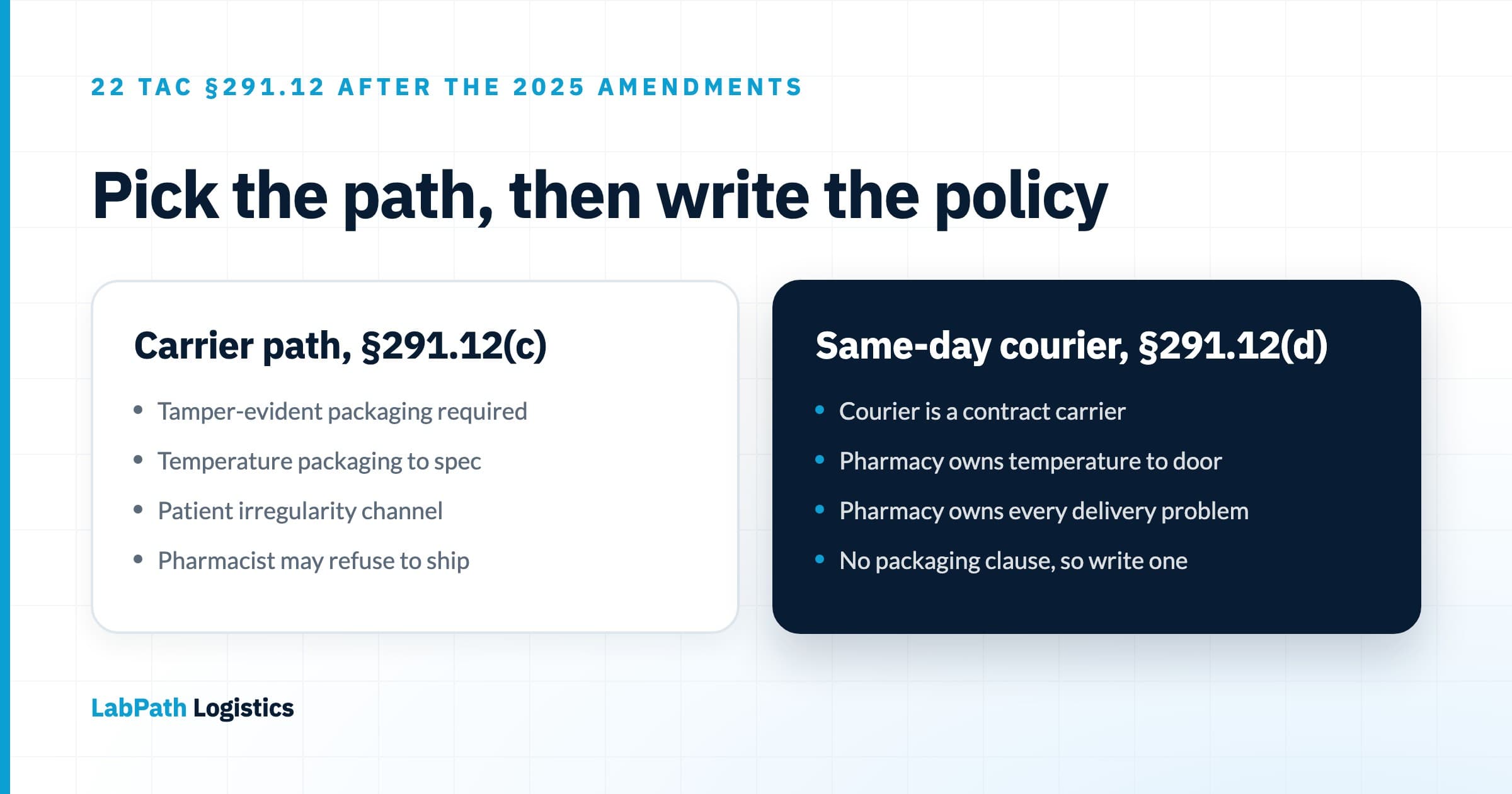
- Path 1, carrier (§291.12(c)): a common or contract carrier that is not providing same-day service, such as a parcel network. The pharmacy must deliver to nationally recognized standards such as the manufacturer's or USP's, use commercially available tamper-evident packaging, package for an appropriate temperature range using tools such as temperature tags, time-temperature strips, insulated packaging, or gel packs, give the patient a way to report late, damaged, or wrong deliveries, and refuse to ship a drug the pharmacist believes the method could compromise. The pharmacy is responsible for any problems in a contract carrier's delivery.
- Path 2, same-day (§291.12(d)): the pharmacy's own employee, or a common or contract carrier providing a same-day courier service. The pharmacy is responsible for any problems in the delivery, and the drug must stay within the USP or manufacturer temperature range until the patient or agent receives it. There is no packaging clause on this path.
- Path 3, drone (§291.12(e)): a carrier providing an unmanned aircraft system delivery service, excluding controlled substances and sterile compounded preparations. The aircraft must hold federal registration, the pharmacist-in-charge must write policies covering eight listed topics, packaging must be tamper-evident and temperature-appropriate, the pharmacy must document each change in chain of custody, confirm the patient is present before launch, and deliver to a reasonably secure spot.
Subsection (f) then applies to all three: counseling under §291.33, notifying the patient that the drug was delivered, replacing any drug a pharmacist finds compromised in transit, keeping two years of records on when each drug was sent and delivered plus any complaints about compromised deliveries, and following state and federal controlled substance law. Our controlled substance courier guide covers that last layer.
2 years
minimum retention for records of when each prescription drug was sent and delivered, and of patient complaints about compromised deliveries, on every delivery path (22 TAC §291.12(f)(4))
Why Is the Same-Day Courier Path the Strictest One?
Because it has the fewest words. Paths 1 and 3 list packaging tools that satisfy the rule: a temperature strip, an insulated box, a gel pack. Path 2 lists none. It sets an outcome instead: the drug stays in range until the patient has it, and the pharmacy answers for anything that goes wrong. A parcel pharmacy can point to the box. A same-day pharmacy has to point to the courier.
That is why the courier's evidence becomes your compliance file. For each run you want the pickup time, the temperature method in the vehicle, the handoff time, and who received it, in a record you can export and keep for two years. Our cold chain pharmacy guide covers the temperature side and our chain of custody guide covers the record. One more point: the rule names confidentiality of prescription records only in the drone policy list, but it belongs on every path. A courier's custody record should carry an order reference and a status, not the prescription itself.
The Eight-Line Delivery Policy: save and send to your pharmacist-in-charge
The rule requires written delivery policies only for drone deliveries, but the eight topics it lists in §291.12(e)(2) are the best checklist in the rule for any path. Write one line for each: (1) training for staff who prepare and package drugs for delivery; (2) how drugs are packaged; (3) how the recipient and address are verified; (4) how prescription records stay confidential in transit; (5) how drugs are securely transferred out of the pharmacy; (6) how counseling is provided; (7) how delivery errors and adverse events are remediated; (8) what records are kept and for how long. Then add a ninth line the rule does not require but every audit will ask for: who signs at each change of custody, and where that record lives.
A Houston Scenario: Refrigerated Refills to Katy
An independent pharmacy in Bellaire fills a refrigerated specialty medication for a patient in Katy who cannot come in. Three honest options exist under the amended rule. A next-day parcel in an insulated box with a temperature strip puts the run on Path 1, where the pharmacist must be satisfied the packaging holds and may refuse to ship if not. A same-day courier puts it on Path 2, where the pharmacy owns the temperature until the handoff and should require the courier's record to prove it. A drone puts it on Path 3, if a carrier serves that address and the drug qualifies.
All three will be used in Houston. In its July 2025 comment letter to the Board, included in the Board's rule analysis, Memorial Hermann Health System supported the amendments and described its engagement with Zipline on drone delivery. The decision for the Bellaire pharmacy is not which path is modern. It is which path the drug, the patient's timing, and the pharmacy's evidence can support. If the patient needs the dose today, Path 2 with a courier that can show temperature control and a timestamped handoff is the defensible choice.
What Should a Houston Pharmacy Ask a Courier Before Signing?
The rule's definition of a contract carrier turns on a bilateral agreement, so the agreement is where the compliance lives. Before signing, ask:
- Does the agreement state which deliveries are same-day courier service, so we know every run is on Path 2 rather than Path 1?
- How do you hold 2 to 8 °C and controlled room temperature in the vehicle, and what record shows it for a specific run?
- What does proof of delivery capture: pickup time, handoff time, recipient, and an order reference rather than prescription details? Can we export it for two years?
- What happens when the patient is not there? We need the drug returned to controlled conditions, not left at a door.
- Do you carry controlled substances, and under what written procedure? If not, say so in the agreement.
- What insurance covers a compromised or lost delivery? Our medical courier insurance guide lists the certificates to request.
Vague answers tell you the evidence will not exist when you need it. Our gig delivery versus medical courier guide explains why app-based drivers rarely clear this list, and our planned service levels show how a dedicated pharmacy lane is structured.
How Do You Choose a Path Without Overbuilding?
Sort by drug and timing, not by vendor. Room-temperature maintenance refills that can wait a day sit comfortably on Path 1. Refrigerated, time-sensitive, or discharge medications usually need Path 2, which is also where hospice and infusion deliveries tend to land. Sterile compounded preparations and controlled substances never go on Path 3, and our compounded sterile preparation guide covers their added rules.
Write the Eight-Line Delivery Policy once for all three paths, then price the lanes that need a courier. The LabPath estimator gives a nonbinding estimate for a same-day or scheduled pharmacy lane in Greater Houston, so the Path 2 decision is made with a number in front of you rather than after a patient calls.
Frequently Asked Questions
Can a Texas pharmacy use a courier to deliver prescriptions?
Yes. Under 22 TAC §291.12(d), a Class A, A-S, E, or E-S pharmacy may deliver prescription drugs through its own employee or a common or contract carrier providing a same-day courier service, at the request of the patient or the patient's agent. The pharmacy remains responsible for any problems in the delivery and must keep the drug within the USP or manufacturer temperature range until the patient receives it.
What is a contract carrier under Texas pharmacy rules?
The 2025 amendments to §291.12 define a contract carrier as a person or entity that transports property for industrial customers under the terms of a bilateral agreement, for compensation, in the normal course of business. A dedicated medical courier working under a signed agreement with a pharmacy fits this definition. A common carrier, by contrast, holds itself out to the general public.
Can drones deliver prescriptions in Texas?
Yes, with limits. Under §291.12(e), a pharmacy may deliver prescription drugs by a carrier providing an unmanned aircraft system delivery service, excluding controlled substances and sterile compounded preparations. The pharmacist-in-charge must write delivery policies, packaging must be tamper-evident and temperature-appropriate, each change in custody must be documented, and the pharmacy must confirm the patient is present at the delivery location before the flight begins.
Who is responsible if a delivered prescription is compromised?
The pharmacy. On every path, §291.12(f) requires the pharmacy to replace a drug a pharmacist determines was compromised in delivery, either by promptly delivering a replacement or by contacting the prescriber so the patient can fill it elsewhere, and to keep records of the complaint for two years. On the same-day courier path, the pharmacy is also responsible for any problem in the delivery itself.