Infusion Drug Delivery Houston: The White Bagging Gap
August 24, 2026 · By LabPath Logistics Editorial Team, Medical Logistics Desk
Quick Answer
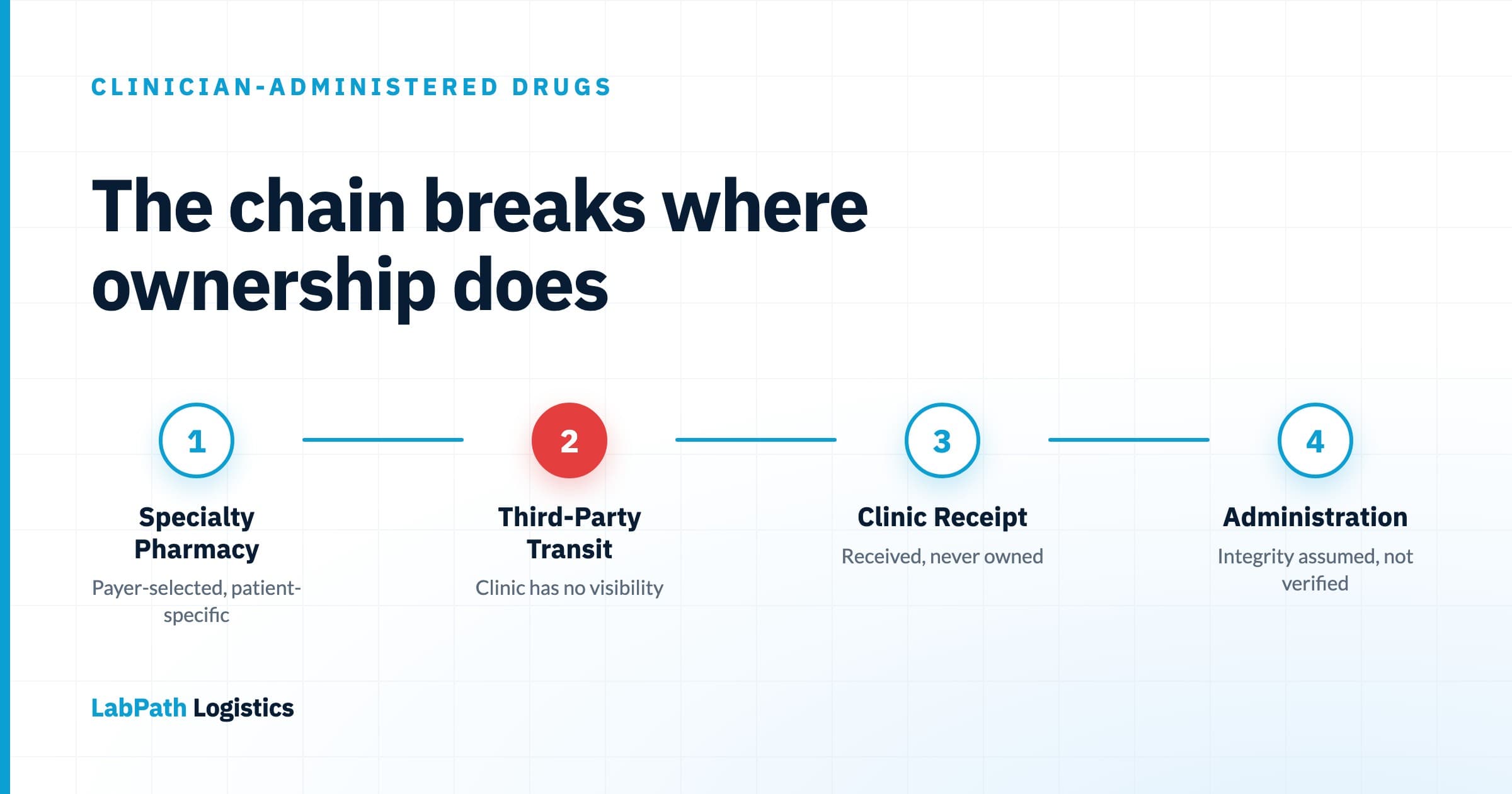
Infusion drug delivery in Houston runs on two different custody models, and only one of them gives the administering site control of the product. Under buy-and-bill, the practice owns the drug, stores it in its own inventory, and can document every leg. Under white bagging, a payer-selected specialty pharmacy ships a patient-specific dose to the clinic, which must store and administer a product it never owned and did not source. Texas Insurance Code §1369.764, added by HB 1647 and effective September 1, 2023, bars health plans from mandating that model for enrollees with chronic, complex, rare, or life-threatening conditions — but §1369.763(b) excludes drugs administered in a hospital, hospital facility-based practice, or hospital outpatient infusion center from the entire subchapter. The practical result is that white-bagged doses still arrive, and the receiving site still needs a written protocol for what happens when one does.
Infusion drug delivery in Houston is not one logistics problem. It is two, and the difference is not the vehicle — it is who holds title to the drug when it comes through the door. A practice that buys its own biologics runs a supply chain it controls end to end. A practice receiving a payer-directed shipment is asked to store, verify, and administer a high-value product it never purchased, from a shipper it did not select, on a schedule it does not set.
Texas took a position on that arrangement three years ago, and most Houston operators know the headline: mandatory white bagging is limited. Fewer know where the limit stops. The statute carries a carve-out that removes a large share of Houston's infusion volume from its protection entirely — so the receiving-dock problem is still live at exactly the sites handling the most of it.
What Texas Changed, and Where It Stops
House Bill 1647 added Subchapter Q to Chapter 1369 of the Insurance Code, effective September 1, 2023, applying to plans delivered, issued for delivery, or renewed on or after January 1, 2024. It defines a clinician-administered drug as an outpatient prescription drug other than a vaccine that cannot reasonably be self-administered and is typically administered by a physician or authorized provider in a physician's office.
Section 1369.764 then prohibits a health benefit plan issuer, for an enrollee with a chronic, complex, rare, or life-threatening medical condition, from doing four things:
- Requiring clinician-administered drugs to be dispensed only by certain pharmacies, or only by in-network pharmacies.
- Limiting or excluding coverage of an otherwise-covered drug based on the enrollee's choice of pharmacy.
- Requiring a network provider to bill the drug under the pharmacy benefit instead of the medical benefit without the patient's informed written consent and a written provider attestation that the resulting delay will not increase the patient's health risk.
- Imposing an extra fee, higher copay, higher coinsurance, or a second cost share based on which pharmacy dispensed the drug.
Those protections are conditional. Under §1369.764(b), they apply only where the treating physician or provider determines that a delay of care would make disease progression probable, or that using an in-network pharmacy would make death or patient harm probable, create a barrier to adherence, or — the clause most relevant here — "because of the timeliness of the delivery or dosage requirements, necessitate delivery by a different pharmacy." The Legislature wrote a logistics trigger directly into an insurance statute.
The carve-out most people miss
Section 1369.763(b) states that the subchapter does not apply to a prescription drug administered in a hospital, hospital facility-based practice setting, or hospital outpatient infusion center. In a market where a large share of infusion capacity sits inside health-system outpatient departments, that exclusion is not a footnote — it decides whether the protection reaches your site at all.
The Custody Gap Is the Operational Problem
$310M
Estimated annual U.S. hospital spend on the clinical, operational, and patient care work created by white and brown bagging, per Vizient's August 2021 analysis of a 260-hospital survey
Vizient's White bagging 101 briefing put that figure at $310 million annually, plus $114 million on additional resources to manage the patient and provider coordination the model creates. That is not drug cost. It is the cost of handling product the organization did not buy.
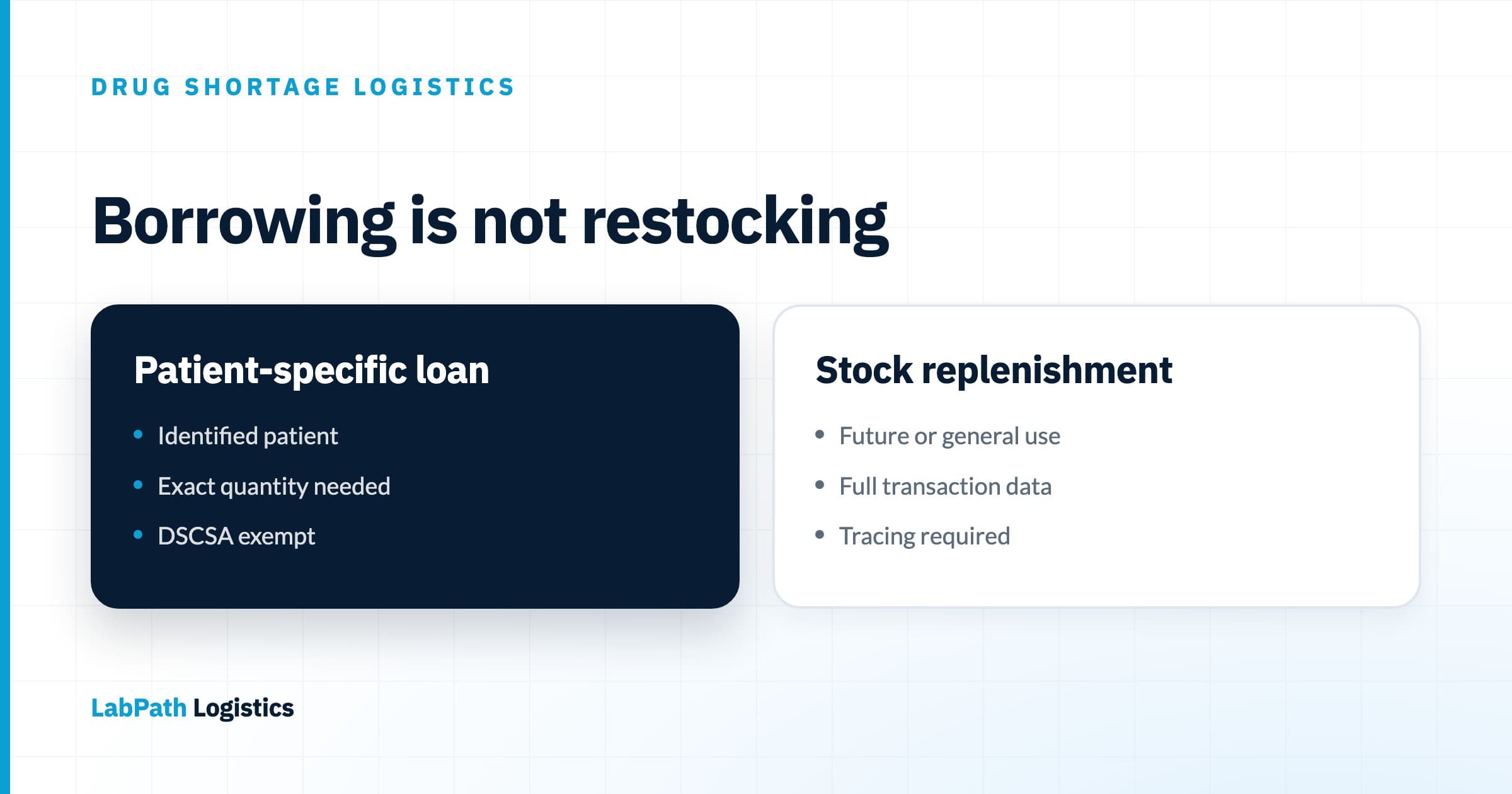
The American Hospital Association and ASHP made the custody argument to the FDA in 2021, describing white-bagged product as a "shadow inventory" that hospitals do not legally own and that sits largely outside the Drug Supply Chain Security Act's track-and-trace requirements. Their operational complaint was more concrete: providers receive these medications without adequate line of sight into the origin or chain of custody of each specific dose.
Translate that into a receiving dock. A refrigerated tote arrives at 4:40 p.m. addressed to a patient whose appointment is Thursday. Nobody at the clinic selected the carrier, saw the packout, or knows what the container's interior temperature did in transit. If it sat in a vestibule for ninety minutes, the record that would prove it belongs to someone else. The nurse administering it Thursday is relying on an assumption, not a document — the exact failure mode we described in our guide to chain of custody in medical courier work.
DSCSA Moved Again on August 6
On August 6, 2026, FDA issued exemptions from certain requirements of section 582 of the FD&C Act for small business dispensers and, where applicable, their trading partners, running until November 27, 2027. A dispenser qualifies as small if, as of November 27, 2026, its owning company has 25 or fewer full-time employees licensed as pharmacists or qualified as pharmacy technicians. FDA asks small dispensers to complete its assessment survey by September 22, 2026.
Read that carefully before anyone treats it as breathing room. The exemption covers the enhanced electronic, interoperable tracing requirements — not the underlying obligations to trade only with authorized partners, maintain product tracing information, and handle suspect product through an established process. And it does nothing for the receiving clinic's actual question, which is not whether the pharmacy's tracing is electronic but whether this container held its temperature between two addresses.
Where This Breaks in Houston
Consider a Houston-area rheumatology group with an infusion suite inside the loop and satellites in Pearland and near the Energy Corridor. A share of its infusion patients are white-bagged under commercial plans. Doses arrive by overnight carrier on a window the group does not control, into offices that close at 5:00 p.m. with one refrigerator and no independent temperature log.
Three predictable failures follow. A dose lands after close and sits until morning. A regimen changes between shipment and appointment, stranding a drug the clinic cannot return, reassign, or bill. A dose goes to the satellite after the patient was rescheduled to the main suite, and someone moves it across town in a personal vehicle with no temperature record and no custody entry. The first two are contracting and scheduling problems. The third is a courier problem — and the one most often handed to whoever is available.
What a Receiving Protocol Has to Do
- Name a delivery cutoff. No clinician-administered drug is accepted after a stated hour, and the shipper is told so in writing before the first shipment, not after the first excursion.
- Log receipt as an event, not a signature. Date, time, receiver, container condition, and any temperature indicator reading, captured when the box is opened rather than reconstructed later.
- Quarantine on arrival. Product goes to a designated, monitored location until a pharmacist or designee releases it — the discipline any product deserves when you cannot attest to its transport conditions.
- Define the excursion decision in advance: who is called, what evidence is gathered, who contacts the dispensing pharmacy, and who documents the disposition. Never make that call at the chairside on infusion day.
- Write the inter-site transfer rule. If a dose moves between your own locations, it moves under the same temperature control and custody record as any other regulated product — never in a personal vehicle as a favor.
- Keep identity off the outside of the container. A patient-specific dose is still a patient-specific record; the leg should carry a code that resolves inside your system, not a name a stranger can read.
Items five and six are where a courier belongs, and they are the two most often improvised. The rest is pharmacy policy, and no vendor should pretend otherwise — though item six follows the principle on our compliance page: the transport record proves custody without carrying patient identity.
Where a Local Courier Actually Fits
The white-bagged leg from a national specialty pharmacy is usually already spoken for. The legs that quietly generate most of the risk are local:
- Inter-site transfers between a main infusion suite and its satellites, under a declared temperature state and a timestamped custody record.
- Same-day runs from a local or health-system specialty pharmacy to an infusion site, where a documented courier leg beats an overnight packout.
- Buy-and-bill replenishment between a central pharmacy and clinic inventory, which is the model Texas law was written to preserve.
- Returns and recall retrievals, which move back with the documentation they moved out with.
All of it is refrigerated-product discipline rather than anything exotic — the same requirements we laid out for cold-chain pharmacy delivery in Houston, applied to a product whose replacement cost runs to thousands of dollars per dose. What the courier leg contributes is the record: what the platform captures at each handoff, so the clinic can answer the temperature question about its own legs even when it cannot answer it about the shipper's.
Key Takeaway
Texas narrowed payer-mandated white bagging for physician-office infusion and left hospital outpatient infusion centers outside the subchapter entirely. Either way, doses the clinic does not own keep arriving on schedules it does not set. The site that writes down a delivery cutoff, a receipt log, a quarantine step, an excursion path, and a rule for moving product between its own buildings has converted an assumption into a record. The site that has not is administering on trust — and trust is not a document you can produce when someone asks what happened to the dose between Tuesday and Thursday.
Frequently Asked Questions
Is white bagging illegal in Texas?
No. Texas restricts payer mandates rather than banning the practice. Texas Insurance Code §1369.764, added by HB 1647 and effective September 1, 2023, prohibits a health benefit plan issuer from requiring clinician-administered drugs to be dispensed only by certain or in-network pharmacies for an enrollee with a chronic, complex, rare, or life-threatening condition — but only where the treating physician determines a delay would make disease progression probable, or that in-network dispensing would make death or harm probable, create an adherence barrier, or, because of delivery timing or dosage requirements, necessitate a different pharmacy. A patient and provider may still choose white bagging voluntarily.
Does the Texas white bagging law cover hospital outpatient infusion centers?
No. Section 1369.763(b) states that Subchapter Q does not apply to a prescription drug administered in a hospital, hospital facility-based practice setting, or hospital outpatient infusion center. The protections reach physician offices and independent infusion sites. If your infusion suite is licensed as a hospital outpatient department, the statute's limits on payer mandates do not apply to it, and your receiving protocol has to do the work instead.
What is the difference between white bagging and brown bagging?
White bagging means a specialty pharmacy ships a patient-specific dose directly to the provider's site for administration by a clinician. Brown bagging means the drug is dispensed to the patient, who transports and stores it and brings it to the appointment. Both remove the administering site from the sourcing decision, but brown bagging also removes any professional control over storage between dispensing and administration, which is why most infusion sites refuse it outright.
What changed with DSCSA on August 6, 2026?
FDA issued exemptions from certain requirements of section 582 of the FD&C Act for small business dispensers, and where applicable their trading partners, through November 27, 2027, to allow time to complete its small dispenser assessment. A dispenser counts as small if, as of November 27, 2026, its owning company has 25 or fewer full-time employees licensed as pharmacists or qualified as pharmacy technicians. The exemption addresses the enhanced electronic, interoperable tracing requirements; it does not suspend the DSCSA obligations already in force, and it does not answer whether a specific container held its temperature in transit.