Gig Apps vs. Medical Couriers for Houston Specimens
October 1, 2026 · By LabPath Logistics Editorial Team, Medical Logistics Desk
Quick Answer
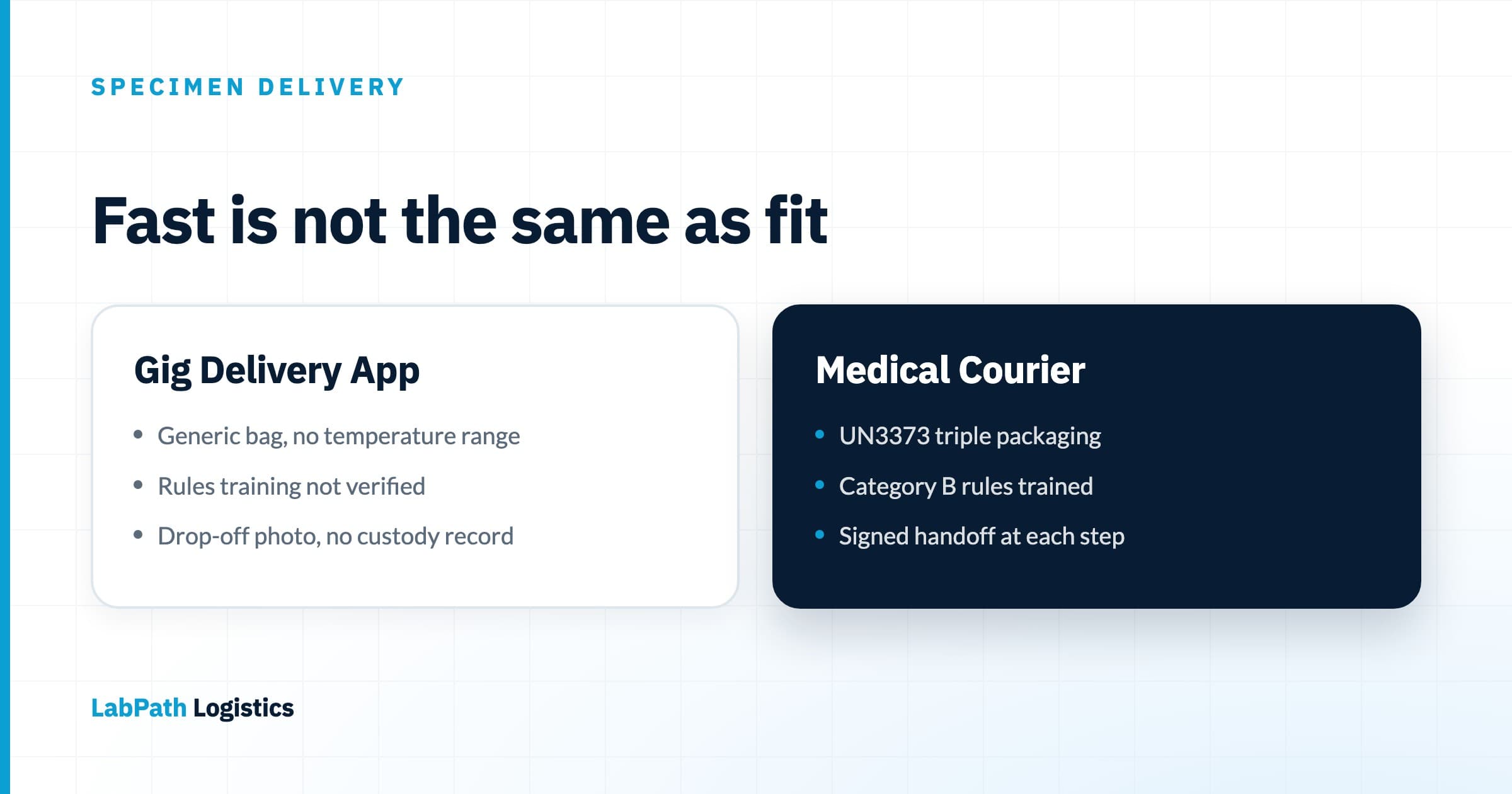
A general gig delivery app can move a box across Houston quickly, but it is not built to carry lab specimens. Specimens shipped as Category B diagnostic samples must travel in triple packaging, the person transporting them must know the federal rules for that packaging, and your lab needs a documented chain of custody and a defined temperature range. A dedicated medical courier is set up to meet those requirements; a general-purpose gig driver usually is not.
Every Houston clinic manager has had the moment: a specimen needs to reach the lab this afternoon, the regular pickup has already run, and a gig delivery app on someone's phone promises a driver in ten minutes. Choosing between a gig delivery app and a medical courier looks like a speed and price decision. For lab specimens, it is really a compliance and specimen-integrity decision.
This guide is for clinic administrators, outreach coordinators, and lab managers deciding who should carry specimens across Greater Houston. It covers what federal rules require of the person transporting a specimen, where general-purpose delivery falls short, and when a dedicated medical courier is worth the difference. It is operations guidance, not legal advice.
The Short Answer
Gig apps are designed for food, parcels, and retail goods. Clinical specimens carry obligations that those platforms do not manage: hazardous materials packaging, a transporter who knows those packaging rules, a temperature range, and a signed record of who held the specimen and when. A medical courier is built around those obligations. If the app cannot show you how it meets each one, it is the wrong vehicle for a specimen, no matter how fast it arrives.
What Federal Rules Require of the Transporter
Most routine diagnostic specimens move by ground as "Biological substance, Category B" (UN3373). Under the U.S. Department of Transportation's hazardous materials rules at 49 CFR 173.199, those packages need a leakproof primary receptacle, leakproof secondary packaging with absorbent material, and a rigid outer package marked with the UN3373 diamond. The completed package must survive a 1.2-meter drop test without leaking from the primary receptacle.
The rule applies to the driver, too
49 CFR 173.199(e) states that each person who offers or transports a Category B infectious substance under that section must know about its requirements. That covers the person in the car, not only the clinic that packed the box.
Then there is bloodborne pathogen exposure. OSHA's standard at 29 CFR 1910.1030 requires employers to train each employee with occupational exposure at initial assignment and at least annually after that. Many gig platforms classify drivers as independent contractors, so ask directly who, if anyone, provides that training and what the driver is told to do if a package leaks. Our overview of DOT and OSHA rules for medical couriers covers both frameworks in more depth.
Where General-Purpose Delivery Falls Short
- Packaging: the app supplies an insulated food bag at best. It does not verify that the package is UN3373-compliant or stop a driver from accepting one that is not.
- Training: there is usually no way to confirm the driver knows Category B rules or has a spill procedure.
- Temperature: there is no declared range, no refrigerant guidance, and no record if the box spends 40 minutes in a hot trunk.
- Custody: a doorstep photo shows where the box ended up, not who held it at each step or when the lab took possession.
- Insurance: personal auto coverage and platform policies are written for consumer deliveries. Confirm in writing whether a specimen run is covered at all.
- Accountability: if a specimen is lost or rejected, there is rarely a named contact, an incident report, or a service-level commitment to escalate.
None of this means gig drivers are careless. It means the platform was not designed for this cargo, so the burden of compliance quietly shifts back to your clinic. Our medical courier insurance checklist lists the coverage questions to ask any carrier.
Why the Lab Cares About the Ride
Transport sits inside what laboratories call the preanalytical phase: everything that happens to a specimen before it is tested. In a widely cited review in Clinical Chemistry and Laboratory Medicine, Mario Plebani reported that preanalytical factors account for 46% to 68.2% of total laboratory errors, far more than the analytical phase.
46–68.2%
Share of total laboratory errors attributed to the preanalytical phase, which includes specimen transport (Plebani, Clinical Chemistry and Laboratory Medicine, 2006)
A delayed, overheated, or unsigned specimen does not fail loudly. It shows up later as a rejection, a redraw, or a result the lab has to qualify. Our post on specimen rejection causes walks through how transport problems surface at the bench.
A Houston Scenario: The 4:30 p.m. Add-On
Picture a family practice in Katy that draws an add-on order after the day's scheduled pickup has left. The specimen needs to reach a reference lab near the Texas Medical Center before its evening cutoff. The front desk books a gig driver, hands over a requisition bag in a paper sack, and gets a drop-off photo 70 minutes later after a slow trip on I-10.
Nothing on that record shows the package was compliant, what temperature it held, or who at the lab accepted it. If the specimen is rejected, the clinic has no data to dispute it and no carrier to hold accountable. The better plan is a standing after-hours or on-demand arrangement with a medical courier, booked before the need arises, with a declared temperature range and a signed handoff at the lab dock. Our chain of custody guide shows what that record should contain.
A Five-Question Test Before Any Specimen Run
- Will the carrier accept only properly packaged UN3373 specimens, and refuse ones that are not?
- Can the carrier show that this driver knows Category B transport rules and has a spill procedure?
- Is there a declared temperature range for this order, and a way to tell if it was held?
- Will you receive a time-stamped record of each handoff, ending with the lab's receipt?
- Is there written insurance coverage and a named contact if something goes wrong?
If the answer to any of these is no, the run is not ready for a specimen. Use the gig app for office supplies, and keep clinical material with a carrier that can answer yes to all five. For a deeper look at the training side, see our guide to vetting medical courier driver training, and for packaging details, our post on Category B specimen packaging.
Frequently Asked Questions
Can I use a gig delivery app to send lab specimens?
It is risky. Ground shipments of Category B diagnostic specimens fall under DOT rules at 49 CFR 173.199, which require triple packaging and state that each person who transports them must know the requirements. Most gig platforms do not verify packaging, driver training, temperature, or chain of custody, so the compliance burden falls back on your facility.
Does a specimen courier need hazmat training?
For Category B specimens transported under 49 CFR 173.199, each person who offers or transports them must know about that section's requirements. If drivers have occupational exposure to blood, OSHA's bloodborne pathogens standard also requires employer-provided training at initial assignment and at least annually.
What should a medical courier provide that a gig app does not?
Look for acceptance of only compliant UN3373 packaging, drivers trained on specimen transport and spills, a declared temperature range, a time-stamped chain of custody ending with the lab's receipt, written insurance for medical cargo, and a named contact for incidents.
Why does the courier leg affect lab results?
Transport is part of the preanalytical phase. A review by Mario Plebani in Clinical Chemistry and Laboratory Medicine attributed 46% to 68.2% of total laboratory errors to preanalytical factors, which include delays and temperature problems in transit.