Tacrolimus Specimen Transport: Same Tube, Different Clock
November 23, 2026 · By LabPath Logistics Editorial Team, Medical Logistics Desk
Quick Answer
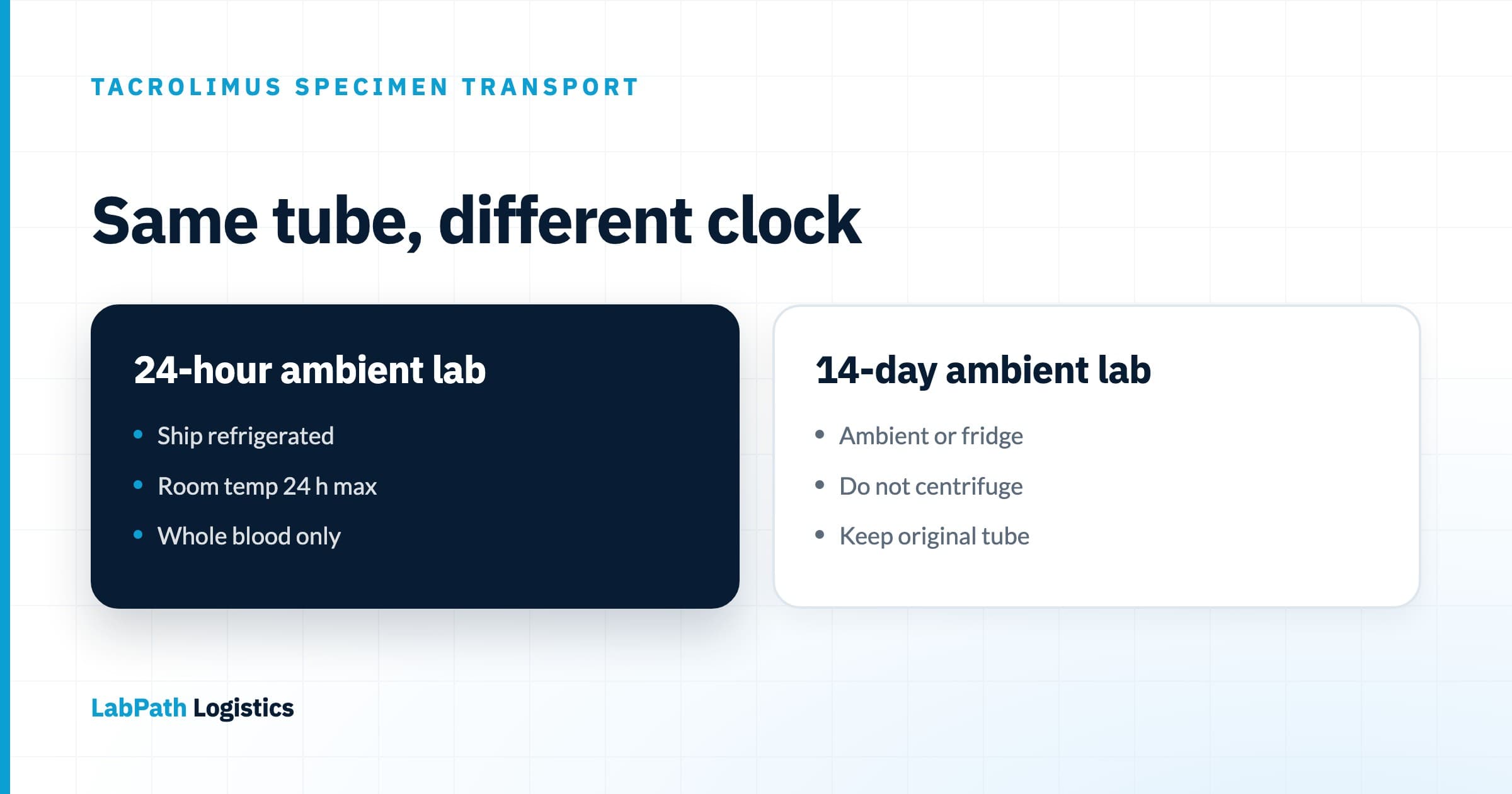
Send tacrolimus as whole blood in a lavender EDTA tube, never spun into serum or plasma, under the performing lab's written rule. Labs disagree: ARUP allows 24 hours at room temperature and ships refrigerated, while Mayo Clinic Laboratories lists 14 days ambient. If you send to more than one lab, plan every tube to the strictest rule.
A tacrolimus tube that one lab would happily accept on Friday can be rejected by another lab on Wednesday. Same patient, same lavender top, same courier. The difference is whose test directory you read. For Houston clinics that send immunosuppressant levels to more than one lab, tacrolimus specimen transport is not a speed problem. It is a which-rule problem.
This guide is for nephrology practices, transplant follow-up clinics, and community clinics that draw levels for patients whose transplant team sits somewhere else. It covers logistics only. Draw timing and dosing belong to the ordering provider and the transplant team. What you get here is one tool, the Trough Lane Card, that turns conflicting lab rules into one plan your staff can follow.
How Should a Tacrolimus Specimen Be Transported?
As whole blood in a lavender EDTA tube, never centrifuged into serum or plasma, under the temperature and time limit the performing lab publishes. Those limits vary widely between labs. If your clinic sends to more than one lab, set your default to the strictest rule, usually refrigerated transport and same-day or next-morning arrival, and you cannot be wrong at either destination.
Why Do So Many Houston Clinics Handle These Tubes?
Transplant volume keeps climbing, and every recipient goes home on medication that is monitored by blood levels. HRSA reported that organ transplants exceeded 48,000 in 2024, a record. Houston hosts several large transplant programs in and around the Texas Medical Center, and recipients spread out across the metro. Many get their routine draws closer to home, at a nephrology office in Sugar Land or a clinic in The Woodlands, and those tubes have to travel to whichever lab the transplant team uses.
48,000+
Organ transplants performed in the United States in 2024, a record. Source: HRSA, Organ Procurement and Transplantation Network announcement, January 2025.
Why Do Labs Give Different Tacrolimus Stability Limits?
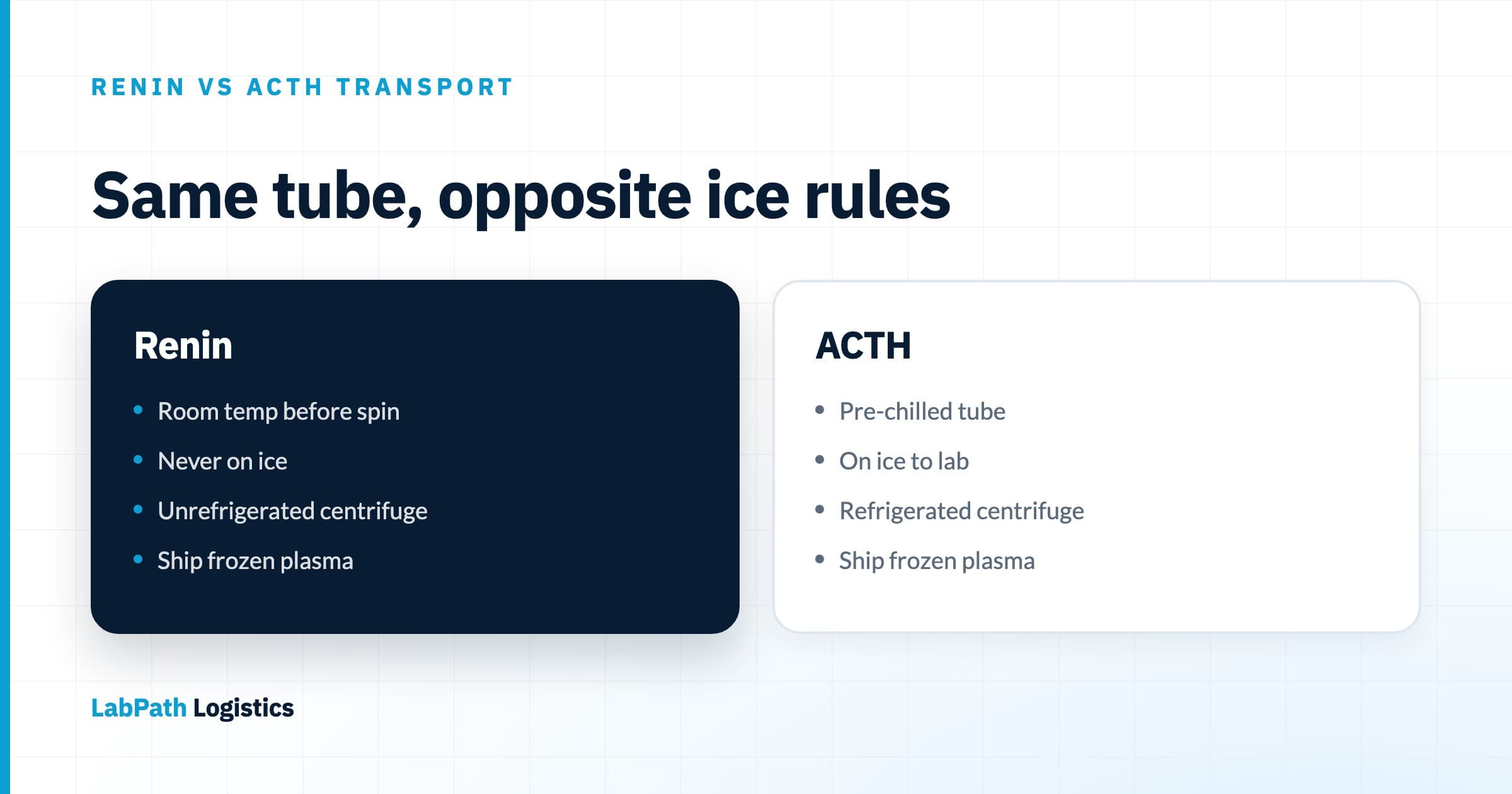
Because each lab validates its own method, tube, and handling, and publishes what it has proven. ARUP Laboratories' tacrolimus by tandem mass spectrometry listing asks for whole blood in a lavender EDTA or pink K2EDTA tube, transported refrigerated. It lists stability of 24 hours ambient, 2 weeks refrigerated, and 2 months frozen. It rejects serum or plasma, clotted specimens, and specimens left at room temperature for longer than 24 hours. It also says predose, or trough, levels should be drawn.
24 hours vs. 14 days
Room-temperature stability for a whole blood EDTA tacrolimus specimen at two national reference labs. Sources: ARUP Laboratories test 0090612; Mayo Clinic Laboratories test 35145.
Mayo Clinic Laboratories' tacrolimus, blood listing gives whole blood EDTA 14 days refrigerated, which it prefers, and 14 days ambient or frozen. It says not to centrifuge or aliquot, and to send the original tube. UChicago Medicine's tacrolimus listing gives 7 days at room temperature or refrigerated and asks off-site clients to send refrigerated. Three labs, three answers. None of them is wrong for its own method. They are wrong for each other.
Where Do Immunosuppressant Levels Go Wrong in Transit?
- The spun tube. Staff who spin every tube by habit turn a whole blood specimen into plasma, and plasma is an unacceptable condition on ARUP's tacrolimus listing. Our HIV viral load guide covers the opposite case, where spinning is required.
- The wrong lab's rule. A clinic that learned the 14-day ambient figure from one lab, then starts sending to a lab with a 24-hour limit, is out of compliance without changing anything it does.
- The warm wait. A tube on a counter over lunch, then in a lockbox through a Houston afternoon, is not refrigerated transport. Our specimen transport temperature guide explains how to hold 2 to 8 °C on the road.
- The mixed panel. A transplant order can include tacrolimus alongside other drugs. Some, like mycophenolic acid, are measured in serum or plasma, and Mayo's listing asks for a red-top serum tube and rejects gel tubes. One draw, two handling rules.
Each of those ends in a redraw. For a transplant recipient, a redraw can mean another trip and another timed draw before the next dose, and a transplant team waiting on a number. That is the real cost, and it is why the lane should be written down before the tube exists.
What Is the Trough Lane Card?
Four lines, filled in once per lab you send to, posted where levels are packed. The card makes the strictest rule the house rule and ties the courier lane to when the result is actually needed.
The Trough Lane Card: save this and send it to your lab lead or transplant coordinator
1. Which lab runs it? Lab name and test code: ___. Its room-temperature limit: ___. Its refrigerated limit: ___. 2. Spin or don't? Tacrolimus: whole blood, do not centrifuge. Any other drug on the order (for example mycophenolic acid): tube and spin rule from that lab: ___. 3. How does it ride? Default to refrigerated, 2 to 8 °C, unless every lab you use allows ambient. Where it waits before pickup: ___ (refrigerator, never a counter or outdoor box). 4. When is the number needed? Ask the transplant team: before the next dose, by the next clinic call, or this week? That answer picks the lane: scheduled pickup ___ (time), or urgent run ___ (who to call, and a backup).
Line 4 is where money gets saved or wasted. Most routine levels do not need a STAT run, because the tube itself is stable for hours to days under the right temperature. They need a predictable refrigerated pickup that reaches the lab inside its window. Our guide to STAT vs. same-day courier tiers shows how to price the rare urgent level separately from the routine lane.
A Houston Scenario: One Clinic, Two Transplant Labs
A nephrology practice west of the city draws morning trough levels for kidney recipients from two different transplant programs. One program's lab is in the Texas Medical Center. The other sends levels to a national reference lab through a drop box. Staff learned one set of rules years ago and apply it to both: tubes sit at room temperature until an afternoon pickup.
For the lab with a long ambient window, that works. For a lab with a 24-hour room-temperature limit, a Friday draw that misses the drop-box cutoff can cross the line over the weekend. With the Trough Lane Card filled in, the practice refrigerates every level as the house rule, puts both labs on one scheduled refrigerated pickup, and keeps one phone number for the day a transplant coordinator asks for a result before the evening dose. Our guide to shared vs. dedicated routes shows when that shared stop is the cheaper lane.
What Should You Do This Week?
- List every lab your immunosuppressant levels go to, and pull each one's current directory entry. Directories change.
- Fill in the Trough Lane Card and post it at the packing station.
- Ask each lab for last quarter's rejections on these tests, by reason: spun, warm, clotted, or late.
- If the courier carries tubes cold, ask how temperature is shown on arrival. Our temperature data logger guide lists what to ask for.
LabPath Logistics is in early access for Greater Houston, with no patient fields in the booking model, by design. A run is booked door to door, and the package code carries no patient data. Our public estimator prices a scheduled shared stop or a one-off urgent run from pickup and drop-off addresses, so you can compare the routine lane and the urgent lane before you commit to either. It is a nonbinding estimate, not a booking quote or a promise of live coverage. Review planned service levels for what is live today, and our HLA crossmatch guide for the other transplant tube that does run on a tight clock.
Frequently Asked Questions
Does a tacrolimus level need to be refrigerated?
It depends on the lab. ARUP Laboratories transports tacrolimus refrigerated and allows only 24 hours at room temperature, while Mayo Clinic Laboratories lists 14 days ambient or refrigerated. If you send to several labs, refrigerate by default so every destination's rule is met.
Should a tacrolimus tube be centrifuged?
No. Tacrolimus is measured in whole blood from a lavender EDTA tube. Mayo Clinic Laboratories says not to centrifuge or aliquot, and ARUP lists serum or plasma as unacceptable. Send the original whole blood tube unless the performing lab says otherwise.
How long is a tacrolimus specimen stable?
Published limits differ. ARUP lists 24 hours ambient, 2 weeks refrigerated, and 2 months frozen. Mayo Clinic Laboratories lists 14 days refrigerated, ambient, or frozen. UChicago Medicine lists 7 days at room temperature or refrigerated. Use the current figure from the lab running your test.
Does a tacrolimus level need a STAT courier?
Usually not for transport stability, since the tube holds for hours to days under the right temperature. Speed matters when the transplant team needs the result before a dosing decision. Ask them when the number is needed, and book the lane to match.