HLA Crossmatch Transport: Houston Transplant Rules
October 30, 2026 · By LabPath Logistics Editorial Team, Medical Logistics Desk
Quick Answer
HLA crossmatch specimen transport is bound by two separate clocks: a CLIA rule (42 CFR 493.1278) requiring the recipient specimen collected the day of transplant, and the organ's own cold ischemia clock, which a slow physical crossmatch can extend by three to six hours. A courier cannot shorten either clock, but a late, undocumented, or mishandled pickup can force the lab to restart testing or report an untimed specimen.
HLA crossmatch specimen transport looks like any other blood draw heading to a lab until you notice what is riding on it: a donated organ, already out of the body, with its own clock running. The specimen itself is not fragile the way a frozen biopsy is. What makes HLA crossmatch specimen transport different is that two separate, federally defined clocks are both ticking on the same courier run, and a Houston transplant program has to satisfy both.
This guide covers the regulatory timing rules, the transport leg's real failure points, and what a histocompatibility lab or organ procurement coordinator should put in writing before the next on-call rotation. It covers logistics and chain of custody only, not clinical crossmatch interpretation.
What Makes HLA Crossmatch Specimen Transport Different From a Routine Pickup?
A routine specimen has one clock: a stability window measured from draw to testing. A transplant crossmatch specimen has two. The first is a documentation clock set by federal law. Under 42 CFR 493.1278(e)(3), a histocompatibility laboratory must have a process to obtain the recipient's specimen collected on the day of the transplant and before transplantation, whenever possible. If that is not possible, the lab must document its efforts to get it. The same regulation, at 493.1278(d)(2)(viii), requires the lab to maintain written criteria defining the time limit between recipient testing and the crossmatch itself.
Day of transplant
42 CFR 493.1278(e)(3) requires a histocompatibility lab to have a process to obtain the recipient specimen collected the day of the transplant, before transplantation, whenever possible — and to document its efforts when it cannot. Source: Cornell Legal Information Institute, 42 CFR 493.1278.
The second clock belongs to the organ, not the paperwork. It is cold ischemia time — the interval between the organ losing its blood supply and the moment it is reperfused in the recipient — and nothing a courier does can pause it. The transport leg's only job on this second clock is to not be the reason it runs longer than it has to.
What Is the Two-Clock Rule for Transplant Crossmatch Transport?
The Two-Clock Rule: save and send to whoever schedules your crossmatch courier
Clock A is the CLIA specimen clock: the recipient sample should be collected the day of the transplant, before transplantation, and every missed attempt needs a documented reason. Clock B is the organ's cold ischemia clock: it never pauses, and a crossmatch that takes hours to complete after the sample arrives eats directly into it. A courier's contract should name which clock it is accountable for. It cannot start or stop either one, but a late pickup, a missed custody scan, or an unsealed container can make both clocks look worse than the transplant team's own performance.
Physical vs. Virtual Crossmatch: Why Does the Transport Leg Still Matter?
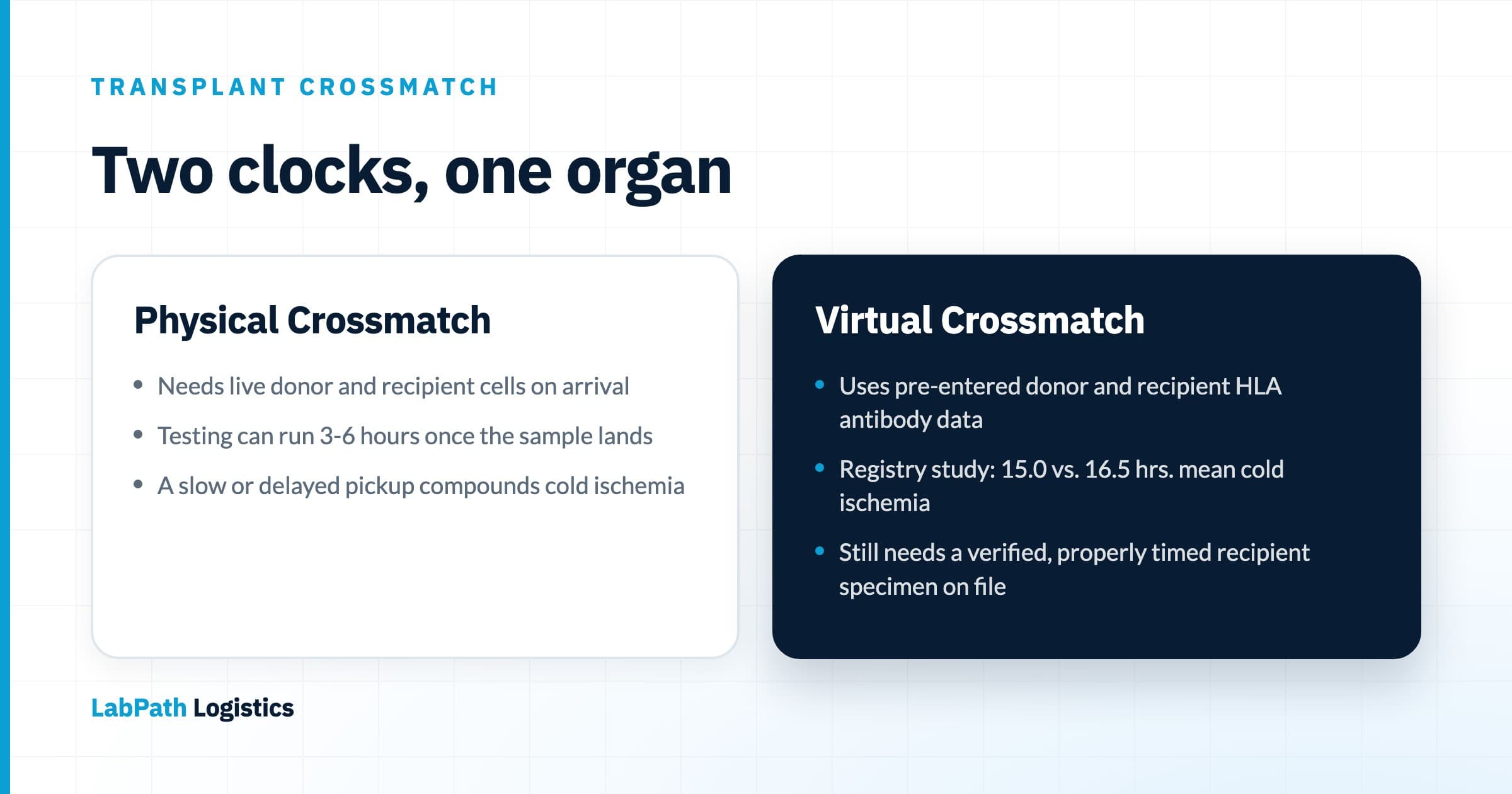
A physical crossmatch mixes live donor and recipient cells and can take three to six hours to complete once the sample arrives at the lab, time that comes directly out of the organ's cold ischemia budget. A virtual crossmatch instead checks the recipient's known antibodies against the donor's HLA typing on file, which is why a registry-based study of kidney transplants found virtual crossmatching associated with a shorter mean cold ischemia time, 15.0 hours versus 16.5 hours for physical crossmatch, without worse graft loss or mortality.
Virtual crossmatch does not remove the transport problem; it relocates it. The lab still needs a verified, correctly timed recipient specimen on file to keep that virtual result current, and OPTN's own histocompatibility guidance for organ procurement organizations calls for enough specimen tubes collected that one can accompany each transported organ, since a specimen that arrives mishandled, such as frozen, cannot yield viable cells for testing. Our bone marrow transport guide covers a related case where three separate clocks govern one specimen.
A Houston Scenario: The 11 p.m. Donor Call
A Houston-area histocompatibility lab supporting a Texas Medical Center transplant program gets an organ-offer call at 11 p.m. The recipient's last on-file specimen is nine days old. Per 493.1278(e)(3), the lab wants a fresh draw the day of the transplant if the recipient is reachable in time. The courier run that follows is not a routine STAT pickup: it is a single tube, a single patient, a single clock that the surgical team is already watching.
If that pickup takes 90 minutes because the courier was already running another route, the lab logs the delay, the transplant team asks why, and the documentation trail becomes part of the record under the same regulation that required the draw in the first place. A dedicated, on-call courier arrangement, not a shared route, is the only design that fits this call pattern. Our shared vs. dedicated route guide covers how to tell which services need which model.
What Should a Houston Transplant Program Require From Its Courier?
- A written on-call response time for crossmatch runs, separate from the facility's routine STAT tier, with the clock starting at the call, not at the next scheduled stop.
- A custody log timestamped at pickup and drop-off, so the lab can satisfy 493.1278(e)(3)'s documentation requirement with a real record instead of a verbal account.
- No freezing and no unapproved hold: cellular crossmatch specimens need to stay within the collecting lab's stated transport temperature, not whatever happens to be convenient en route.
- Confirmed tube type on pickup against the receiving histocompatibility lab's own requisition, since recipient and donor draws commonly specify different tube types for the same crossmatch.
- A named point of contact who can be reached directly during an active organ offer, not a general dispatch queue.
These are vendor-management questions, and they belong in the contract before the next 2 a.m. call, not after a missed one. Our vendor credentialing guide and contract terms guide cover the clauses to redline for any specialty courier relationship, and the same CAP and CLIA specimen-handling discipline that applies to routine send-outs applies here, covered in our CAP specimen transport guide.
LabPath Logistics is in early access for Greater Houston. Our locally verified booking-to-receiver-attestation workflow records package-QR scans, pickup evidence, append-only custody events, and receiver signature; production dispatch, GPS, and temperature telemetry are not live yet, and we make no fixed-minute pickup promise. The booking model has no patient data fields, by design — a transplant crossmatch run travels as an order reference, not a patient record. Ask us what custody documentation an early-access histocompatibility route would produce. See the platform preview and services, or price a dedicated lane in the nonbinding estimator.
Frequently Asked Questions
How soon before a transplant must the recipient's crossmatch specimen be collected?
Under 42 CFR 493.1278(e)(3), the histocompatibility lab must have a process to obtain the recipient specimen collected on the day of the transplant and before transplantation, whenever possible. If that is not possible, the lab must document its efforts to obtain it.
Does virtual crossmatch remove the need for specimen transport?
No. Virtual crossmatch checks existing donor and recipient HLA data instead of mixing live cells, which a registry study linked to shorter mean cold ischemia time. The lab still needs a current, properly timed recipient specimen on file, so transport and documentation requirements still apply.
Who is responsible for cold ischemia time during specimen transport — the courier or the lab?
Neither party controls the clock itself; cold ischemia time starts when the organ loses its blood supply. The courier's responsibility is narrower: not adding avoidable delay to a crossmatch process that is already part of that timeline, and documenting exactly when pickup and drop-off occurred.
What happens if a histocompatibility lab cannot get a same-day recipient specimen?
The regulation does not require the transplant to stop. It requires the lab to document its efforts to obtain the specimen when a same-day draw was not possible, which makes the courier's timestamped custody record part of that compliance documentation.