Respiratory Specimen Transport in Houston
October 2, 2026 · By LabPath Logistics Editorial Team, Medical Logistics Desk
Quick Answer
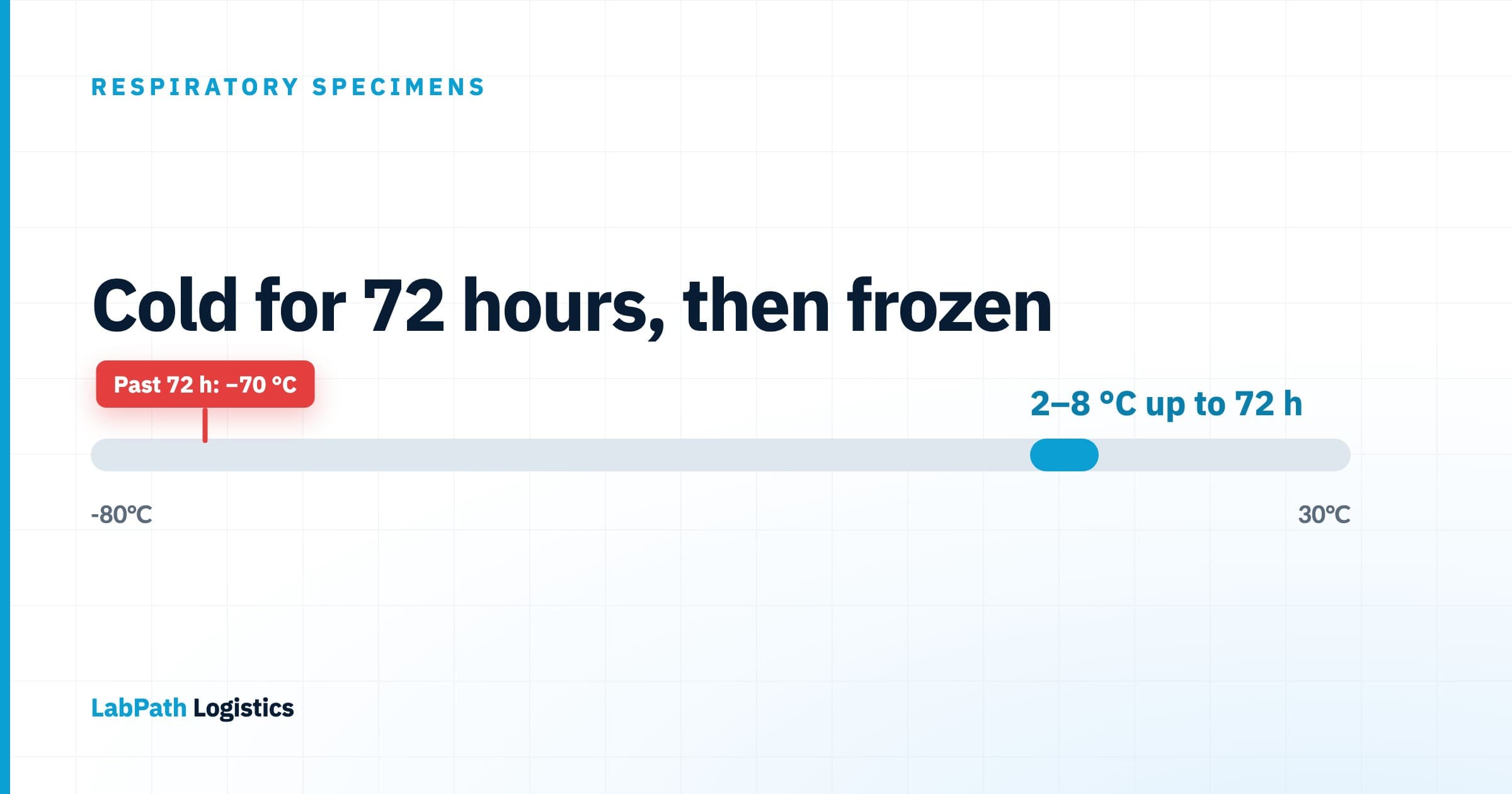
Respiratory swabs in viral or universal transport media should travel refrigerated at 2–8 °C, not at room temperature. The Texas DSHS Laboratory accepts refrigerated influenza PCR specimens only if they arrive within 72 hours of collection; past that point they must be frozen at −70 °C and shipped on dry ice. Specimens received ambient, received cold after 72 hours, or collected in expired media are rejected, so the courier's job is to keep the swab cold and get it to the lab inside the window.
October is when respiratory swab volume starts to climb, and with it the number of specimens that sit in a clinic drawer, ride in a warm car, or reach the lab a day late. Respiratory specimen transport in Houston looks simple — a swab in a tube of liquid — but the transport medium has a temperature range and a clock, and the receiving lab enforces both. Get them wrong and the result is a rejected specimen and a patient called back for a second swab.
This guide is for Houston clinic managers, urgent care operators, long-term care directors, and lab outreach teams who send influenza, COVID-19, and RSV swabs to a hospital lab, a reference lab, or a public health laboratory. It covers the handling rules, where the courier leg fails, and how to set up pickups before the season peaks. It is logistics guidance only, not clinical advice.
The Rules: 2–8 °C, 72 Hours, Then Frozen
The clearest published standard for Texas facilities comes from the state laboratory itself. For its influenza real-time RT-PCR test, the Texas DSHS Laboratory accepts swabs in viral transport media (VTM) or universal transport media (UTM) and sets two handling paths based on when the specimen will arrive.
- Arriving within 72 hours of collection: refrigerate at 2–8 °C and ship overnight on cold packs.
- Arriving more than 72 hours after collection: freeze at −70 °C and ship overnight on dry ice.
72 hours
Texas DSHS Laboratory rejects influenza PCR specimens received cold more than 72 hours after collection
The same DSHS page lists the rejection criteria, and several of them are transport failures rather than collection failures: a specimen received ambient, a specimen received cold more than 72 hours after collection, expired transport media, and a mismatch between the submission form and the tube label. Hospital and commercial labs publish their own requirements in their test directories, and those govern for their assays. Use the DSHS rules as a baseline, then confirm each receiving lab's version.
Your freezer is probably not −70 °C
A standard clinic freezer runs around −20 °C, which is not the −70 °C the DSHS lab specifies for delayed specimens. If a swab cannot reach the lab inside 72 hours, ask the lab what it wants before you freeze anything. Our guide to [frozen specimen transport on dry ice](/blog/frozen-specimen-transport-dry-ice-houston) covers the shipping side.
Why Peak Season Is When Transport Breaks
The last flu season showed how heavy the load can get. CDC's 2024–2025 season summary classified it as a high severity season across all ages, with an estimated 51 million illnesses, 23 million medical visits, and 710,000 hospitalizations. Every one of those medical visits is a potential swab, and swabs arrive in waves that routine pickup schedules were not built for.
When volume spikes, the failure pattern is predictable: a once-a-day pickup leaves late-afternoon swabs at room temperature overnight, a full cooler gets topped off with tubes that never touched a cold pack, and Friday collections sit through the weekend until they cross the 72-hour line. We covered contract-level surge planning in our post on courier capacity for flu season; this post is about the handling rules each pickup has to meet.
Where the Courier Leg Fails
- Swabs wait at room temperature at the front desk instead of in a 2–8 °C refrigerator before pickup.
- Cold packs come straight from the shelf rather than conditioned in the refrigerator, so the cooler is not cold.
- Collection time is not on the tube or requisition, so the lab cannot verify the 72-hour window.
- Friday afternoon swabs miss the last pickup and wait until Monday.
- Transport media past its expiration date is used at collection, and the lab rejects the specimen on arrival.
- Swabs ride loose in a bag with ambient routine specimens, so no one can say what temperature they held.
Collection technique matters too, even though it happens before the courier arrives. CDC's specimen collection guidance calls for synthetic fiber swabs with thin plastic or wire shafts, and warns against calcium alginate swabs or wooden shafts because they may inactivate some viruses and inhibit molecular tests. The best courier in Houston cannot fix a specimen collected on the wrong swab.
A Houston Scenario: The Friday Swab
Picture an urgent care clinic in Pearland that collects a nasopharyngeal swab at 5:40 p.m. on a Friday in January. The last scheduled pickup left at 4:30. The swab goes into the clinic refrigerator — the right move — but the next pickup is Monday morning. Collection to arrival is now close to 66 hours, with a Monday traffic day on Highway 288 still ahead. One delayed route and the specimen crosses 72 hours, and the lab rejects it.
The fix is a schedule, not a heroic driver. Add a late Friday pickup during respiratory season, or a Saturday run timed to the receiving lab's weekend receiving hours. Write the collection date and time on every tube. And give the clinic one rule for staff: if the swab is not in the refrigerator, it is not ready for pickup.
Packaging: Category B and Triple Packaging
Diagnostic respiratory specimens moving to a lab are generally shipped as Biological Substance, Category B (UN3373), and the DSHS lab requires them to be triple-contained under federal infectious-substance shipping rules. The packaging standard is 49 CFR 173.199: a leakproof primary tube, a leakproof secondary bag with absorbent material, and a rigid outer package. Our guide to Category B specimen packaging walks through each layer, and our specimen transport temperature guide explains how refrigerated, frozen, and ambient lanes differ.
A Pre-Season Checklist for Clinics
- Pull the current specimen requirements from every lab you send respiratory swabs to, and note each one's temperature and time limits.
- Check transport media stock for expiration dates and rotate before the surge.
- Designate a 2–8 °C refrigerator spot for swabs awaiting pickup, separate from ambient specimens.
- Condition cold packs in the refrigerator so they are cold before they go in the cooler.
- Require collection date and time on every tube and requisition, and match the tube label to the form.
- Add a late-day or weekend pickup for respiratory season so no swab waits past the lab's window.
- Track rejections by reason so transport failures surface in weeks, not months.
Rejections are the best signal you have. Our post on specimen labeling errors shows how to separate labeling failures from transport failures, and our microbiology transport guide covers the specimens that should not be refrigerated.
Frequently Asked Questions
What temperature should a flu or COVID swab be transported at?
Swabs in viral or universal transport media are generally refrigerated at 2–8 °C. The Texas DSHS Laboratory, for example, requires refrigerated specimens on cold packs if they will arrive within 72 hours of collection, and rejects specimens received at ambient temperature. Always confirm with the receiving lab.
How long is a respiratory swab in transport media good for?
For influenza PCR, the Texas DSHS Laboratory accepts refrigerated specimens that arrive within 72 hours of collection. Specimens that will arrive later must be frozen at −70 °C and shipped on dry ice. Other labs set their own stability limits in their test directories.
Can respiratory swabs be shipped at room temperature?
Not for the DSHS influenza PCR test, which lists specimens received ambient as a rejection reason. Some commercial assays and collection devices are validated for room temperature, so the receiving lab's directory is the only reliable answer.
Are respiratory swabs Category B specimens?
Diagnostic respiratory specimens are generally shipped as Biological Substance, Category B (UN3373), in triple packaging that meets 49 CFR 173.199. Specimens from suspected high-consequence pathogens follow different rules set by the receiving public health laboratory.