Radiopharmaceutical Transport: Houston Class 7 Rules
August 28, 2026 · By LabPath Logistics Editorial Team, Medical Logistics Desk
Quick Answer
Radiopharmaceutical transport is governed by the US Department of Transportation's Class 7 (radioactive material) rules in 49 CFR, not by the general medical-courier practices that cover specimens and pharmaceuticals. A common carrier does not need its own radioactive materials license to move the product — 10 CFR 30.13 exempts carriers transporting byproduct material in the regular course of carriage — but the hazmat training, radiation-level, labeling, and separation-distance rules apply in full, and the shipping licensee stays responsible for the package under Texas rules. The second constraint is arithmetic: fluorine F 18 has a physical half-life of 109.7 minutes, so a 30-minute detour deletes roughly 17 percent of the activity a patient was scheduled to receive.
Every other package a medical courier carries is stable while it sits in the van. A radiopharmaceutical is not. The product is measurably smaller at the destination than it was at the door, and unlike a temperature excursion, nobody can undo it, inspect around it, or argue about whether it mattered. Radiopharmaceutical transport is the one category where the delay itself is the damage.
It is also the category where the legal regime changes underfoot. A courier that is fully competent to carry Category B specimens, refrigerated pharmaceuticals, and controlled substances may be flatly unqualified to carry a PET dose across the street. The rules are not stricter versions of the same rules — they are a different set, written by a different agency, keyed to radiation levels rather than to spill containment.
The Clock Starts Before Anyone Calls the Courier
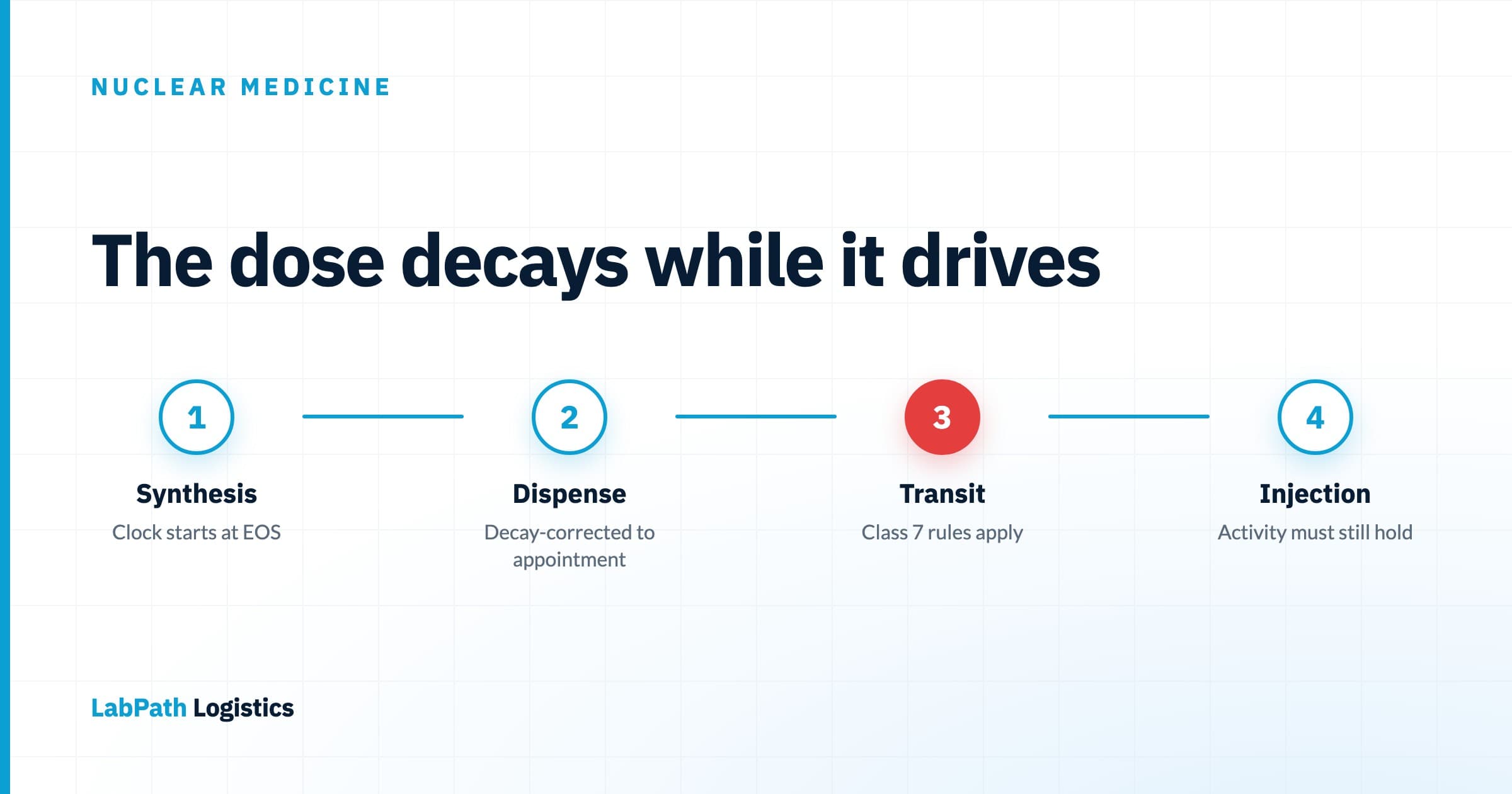
The FDA-approved labeling for Fludeoxyglucose F 18 Injection sets out the two numbers that govern the entire logistics problem: fluorine F 18 "decays by positron (β+) emission and has a half-life of 109.7 minutes," and the product "should be used within 12 hours of the end of synthesis (EOS)." The label also instructs that the patient dose be "calculated using proper decay factors from the time of the end of synthesis."
Read that operationally. The radiopharmacy dispenses backward from a scheduled injection time, adding activity to compensate for the decay it expects during transport and handling. That calculation is a prediction about your courier. If the drive takes longer than the dispensing assumption, the dose that arrives is smaller than the dose that was prescribed.
17%
Share of fluorine F 18 activity lost to physical decay across an unplanned 30-minute delay, computed from the 109.7-minute half-life stated in the FDA-approved labeling for Fludeoxyglucose F 18 Injection. At 60 minutes the loss is about 32 percent; at 110 minutes, roughly half.
Technetium-based studies are more forgiving but not exempt. The Nuclear Regulatory Commission describes the standard supply chain plainly: molybdenum-99 "decays with a 66-hour half-life to technetium-99m (Tc-99m), which in turn decays with a 6-hour half-life," and generators are "sent to hospitals, medical centers, or radiopharmacies" from a manufacturer. A six-hour half-life absorbs an hour of Houston traffic — roughly an 11 percent loss — in a way that a 109.7-minute half-life simply cannot.
Decay is not an exception. It is the baseline.
A cold-chain excursion is an event you investigate. Decay is continuous, predictable, and already priced into the dispensed activity. That is why radiopharmaceutical routing is scheduled to the minute rather than to a window: the schedule is not a service preference, it is an input to the dose calculation.
Class 7 Is a Different Legal Regime, Not a Stricter One
The first thing most facility managers get wrong is assuming the courier needs a radioactive materials license. It generally does not. Under 10 CFR 30.13, common and contract carriers, freight forwarders, warehousemen, and the Postal Service are exempt from those licensing requirements "to the extent that they transport or store byproduct material in the regular course of carriage for another or storage incident thereto."
What replaces the license is the DOT hazardous materials framework, and in Texas the state rule points straight at it. Texas is an Agreement State, and 25 TAC §289.257(e)(1) requires each licensee transporting radioactive material outside the site of usage, transporting on public highways, or "delivering radioactive material to a carrier for transport" to comply with the applicable DOT requirements in 49 CFR Part 107, Parts 171–180, and Parts 390–397.
Two consequences follow, and they cut in opposite directions. The courier is not the licensee, so the radiopharmacy retains responsibility for the package as offered. But the courier is a hazmat employer, so the training, handling, and radiation-level rules land on it directly — the same structure we walk through for DOT and OSHA obligations in medical courier work, applied to a class most couriers never touch.
The Four Requirements That Disqualify Most Couriers
Each of these is verifiable from outside the company, which makes them the right questions for a vendor review rather than a legal memo.
- Radiation levels on the package. Under 49 CFR §173.441(a), a package offered for transport must not exceed 2 mSv/hour (200 mrem/hour) at any point on the external surface, with a transport index no greater than 10. Anything above that must move as an exclusive use shipment.
- Radiation levels in the vehicle. For exclusive use shipments, §173.441(b)(3) caps the level at 0.1 mSv/h (10 mrem/h) at any point 2 meters from the outer lateral surfaces, and §173.441(b)(4) caps it at 0.02 mSv/h (2 mrem/h) in any normally occupied space — with a carve-out only for carriers operating under a state or federally regulated radiation protection program whose personnel in that space wear dosimetry devices.
- Separation distance in the vehicle. Under 49 CFR §177.842(b), packages labeled RADIOACTIVE YELLOW-II or YELLOW-III may not be placed closer than the distances in the regulation's table to any area that may be continuously occupied, or to any package of undeveloped film. The table scales with total transport index and transit duration.
- Hazmat training on a documented clock. 49 CFR §172.704(a) requires general awareness, function-specific, safety, and security awareness training; §172.704(c)(1)(ii) requires a new hazmat employee to complete it within 90 days of employment, and §172.704(c)(2) requires recurrent training at least once every three years.
The second item is the quiet disqualifier. A cargo van with a single row of seats has one normally occupied space, and it is the driver's. Meeting a 2 mrem/h limit there is a matter of shielding geometry and package placement, not good intentions — and the alternative path through the carve-out requires an actual radiation protection program with dosimetry, not a policy document. That is a real operating structure with real overhead, which is exactly why so few general medical couriers carry Class 7.
What This Looks Like on a Houston Map
Consider a Houston-area PET imaging center that books morning slots and receives unit doses from a commercial radiopharmacy across town. The dose is dispensed against a 9:15 injection. The driver leaves on time, hits a closure on the 610 Loop, and arrives at 9:47.
Nothing was spilled, nothing was warmed, and no chain of custody was broken. The scan still degrades, because roughly a fifth of the activity is simply gone. The center's options are to accept a lower-count study, to re-dispense — which means a second delivery on the same decaying clock — or to reschedule the patient. All three are worse than the 32 minutes suggest.
Now extend the same map. That imaging center also moves things all day that are not Class 7 at all: blood work drawn before a stress test, pathology going to a reference lab, chart packets and consent forms between a satellite and a hospital campus, supplies and consumables between sites. Those legs are ordinary medical courier work, and they are frequently bolted onto the radiopharmacy contract for no better reason than that the radiopharmacy was already driving.
What to Verify Before You Route a Dose
- Written confirmation that the carrier accepts Class 7, in the specific transport index range you ship — general hazmat authorization is not the same authorization.
- Per-driver hazmat training records dated within 90 days of hire, with the three-year recurrence documented, not asserted.
- A stated method for meeting the 2 mrem/h occupied-space limit: shielding and placement, or a radiation protection program with dosimetry under §173.441(b)(4).
- A shipping-paper and emergency-response-information practice that survives a roadside inspection, including the carrier's own copy of the separation-distance rule.
- A named escalation path for a delayed dose, agreed with the radiopharmacy, that ends in a decision rather than a phone call.
If a courier answers the first question with "we handle medical," that is a no. Class 7 authorization is a discrete thing a company either has or does not have, and the honest ones say so immediately — the same standard we apply to driver training and credential verification generally.
Where We Fit — and Where We Do Not
LabPath Logistics does not transport Class 7 radioactive material, and we would rather say that in a blog post than in a sales call. Unit doses and generators belong with a carrier built for them: hazmat-endorsed drivers, dosimetry, shielded transport containers, and a dispatch model that treats the dose calculation as a hard constraint.
What we do carry is everything else moving around a nuclear medicine program — the pre-scan labs, the pathology, the inter-site paperwork, the supplies — on timestamped custody with an opaque identifier rather than a patient name. Separating those legs from the radiopharmacy contract usually costs less and always produces a cleaner record, because a Class 7 carrier's routing is dictated by decay windows that have nothing to do with when your reference lab's courier cutoff is.
Key Takeaway
Radiopharmaceutical transport fails differently from every other medical delivery: not by contamination or breach, but by subtraction. The regulatory answer is narrow and checkable — Class 7 authorization, documented hazmat training, radiation levels inside the limits in §173.441, separation distances under §177.842. The operational answer is narrower still. Ask what the dispensing assumption was, then ask whether your carrier's schedule can actually hold it. And keep the non-radioactive legs on a route that is optimized for your lab's clock instead of the isotope's.
Frequently Asked Questions
Does a medical courier need a radioactive materials license to transport radiopharmaceuticals?
Generally no. 10 CFR 30.13 exempts common and contract carriers, freight forwarders, warehousemen, and the US Postal Service from those licensing requirements to the extent they transport or store byproduct material in the regular course of carriage for another. What applies instead is the DOT hazardous materials framework in 49 CFR — hazmat employee training, package radiation limits, labeling, shipping papers, and separation distances. In Texas, 25 TAC §289.257(e)(1) requires the shipping licensee to comply with those DOT rules when delivering radioactive material to a carrier, so responsibility for the package as offered stays with the radiopharmacy.
How much activity does a PET dose lose during a delayed delivery?
It depends entirely on the isotope. Fluorine F 18 has a physical half-life of 109.7 minutes according to the FDA-approved labeling for Fludeoxyglucose F 18 Injection, so a 30-minute delay removes about 17 percent of the activity, an hour removes about 32 percent, and roughly 110 minutes removes half. Technetium-99m, with a 6-hour half-life, loses about 11 percent over an hour. Because the radiopharmacy dispenses with decay correction against a scheduled injection time, any delay beyond that assumption produces an administered dose lower than the one prescribed.
What radiation levels are allowed on a package and inside the vehicle?
Under 49 CFR §173.441(a), a package of Class 7 material offered for transport must not exceed 2 mSv/hour (200 mrem/hour) at any point on its external surface, with a transport index of 10 or less; anything higher must move as an exclusive use shipment. For exclusive use shipments, §173.441(b)(3) limits the level to 0.1 mSv/h (10 mrem/h) at 2 meters from the vehicle's outer lateral surfaces, and §173.441(b)(4) limits it to 0.02 mSv/h (2 mrem/h) in any normally occupied space, unless the carrier operates under a state or federally regulated radiation protection program and the personnel in that space wear dosimetry devices.
Can the courier that picks up our specimens also deliver our PET doses?
Only if that courier separately holds Class 7 authorization and can document it. General medical courier competence — Category B specimen packaging, cold chain, controlled substances — does not extend to radioactive material, because the governing rules are keyed to radiation levels rather than to spill containment. In practice most facilities run two carriers: one built around the isotope's decay window for the doses, and a general medical courier for the labs, pathology, documents, and supplies that move on the facility's own schedule.