Staff Driver vs Medical Courier: A Houston Break-Even
October 19, 2026 · By LabPath Logistics Editorial Team, Medical Logistics Desk
Quick Answer
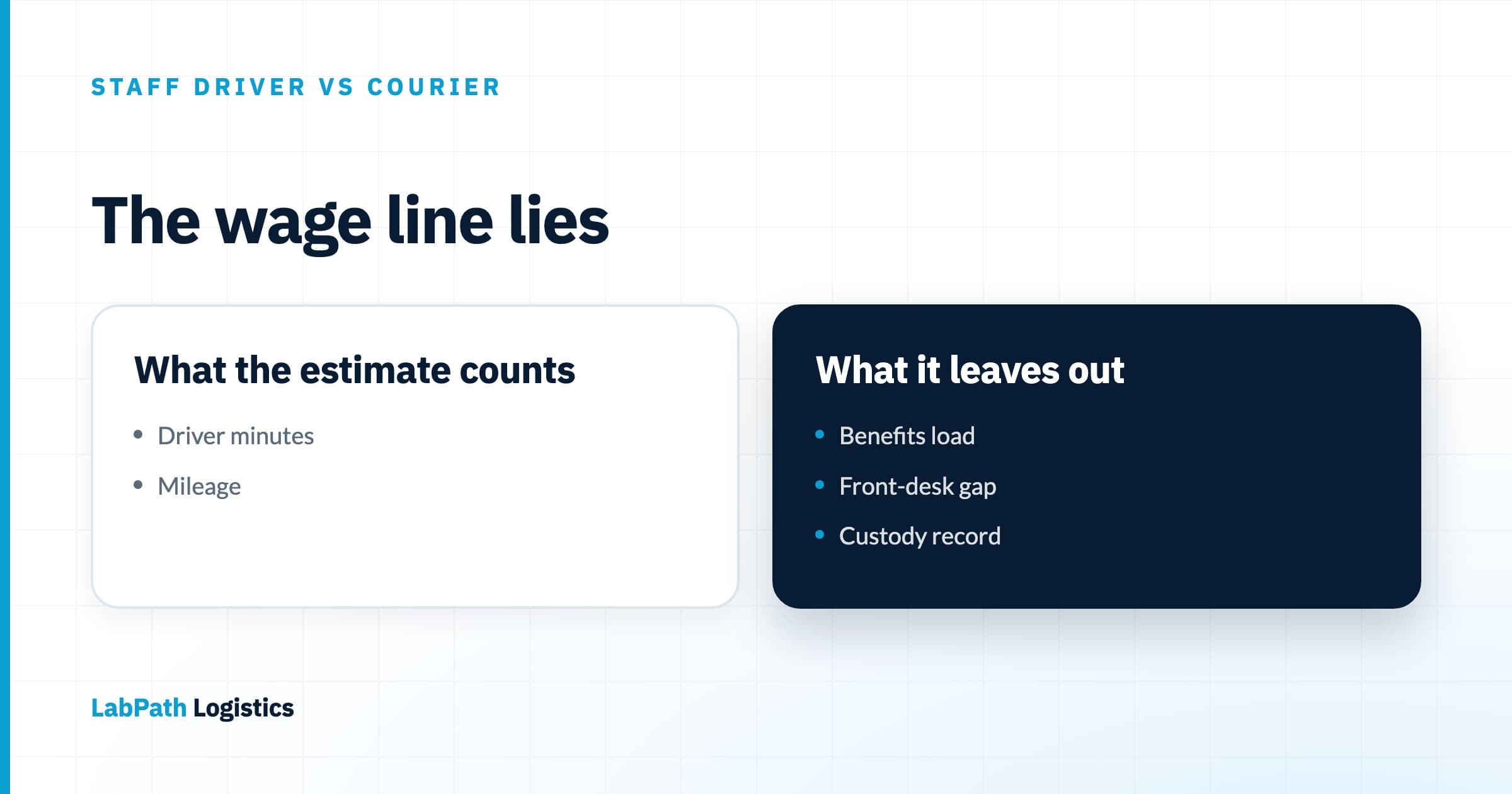
On wages alone, a staff member driving specimens is often cheaper per trip than a courier. The decision turns on three costs the wage line omits: the benefits load on that employee's time, the front-desk or clinical gap while they are gone, and the custody record a courier supplies. Run six lines of arithmetic with your own numbers before deciding.
Most Houston clinic managers who ask whether a medical courier is worth it start with the same math: one employee, one drive, one hourly wage. Done that way, the staff driver usually wins, and the courier quote looks like an extra expense for something the clinic already does for free. That conclusion is where most clinics stop, and it is why the same clinics later discover they have been paying for specimen runs in places no spreadsheet shows.
This guide gives you a method we call the Six-Line Break-Even: six lines of arithmetic you fill in with your own numbers, in about ten minutes, before you sign a courier agreement or decide to keep driving. It will not tell you the courier is always the better buy. It will tell you which of your own numbers decide it.
Is a Staff Driver Cheaper Than a Medical Courier?
Per trip, on the wage line alone, often yes. A medical assistant earning the national median costs the clinic less per hour than a stop-based courier charges per pickup, so a single short run looks cheaper in-house. The honest answer changes once you price the whole trip: the full cost of that employee's hour, what the clinic does without them, and what record exists afterward.
$21.25
per hour, the May 2024 median wage for medical assistants in the U.S. (U.S. Bureau of Labor Statistics, Occupational Outlook Handbook)
The BLS figure is a national median, so substitute your own payroll rate. It is also a wage, not a cost to you, which is the first thing the break-even corrects.
The Six-Line Break-Even
- Runs per week. Count every specimen trip in a normal week, including the one-off "we forgot a tube" drive.
- Minutes per run, door to door. Time one honest round trip at your actual pickup hour, including parking, check-in at the lab, and the return. Houston traffic at 4:30 p.m. is not the number from a mapping app at 10 a.m.
- Loaded hourly cost of the driver. Take the employee's wage and divide by the wage share of total compensation. BLS reports that wages and salaries were 70.0 percent of private-industry employer compensation costs in June 2026, so a $21.25 wage loads to roughly $30 an hour.
- Mileage and wear. Multiply miles by your reimbursement rate. If staff drive personal cars, this line is real money you are already paying or owing.
- The gap cost. When the driver leaves, who answers the phone, rooms the next patient, or runs the draw? If someone is pulled off other work, or a visit slips, price that. If no one is affected, write zero and be honest about it.
- The record cost. If a specimen is questioned at the lab, can you show who held it, when, and where it went? If the answer is a text message, price what an hour of reconstruction and a possible recollection costs.
Lines one through four are the staff driver's visible cost. Lines five and six are the invisible ones. Multiply lines one through four by 52 for the annual figure, add whatever you honestly put on lines five and six, and compare the total to a courier quote for the same lane.
The Six-Line Break-Even: save and send to your practice manager
(1) Runs per week. (2) Door-to-door minutes per run at the real pickup hour. (3) Loaded hourly cost: wage divided by about 0.70. (4) Mileage and wear. (5) Gap cost: the work not done while the driver is out. (6) Record cost: what it costs when you cannot show custody. Annual staff cost = (runs × minutes ÷ 60 × loaded rate + mileage) × 52, plus lines 5 and 6. Compare to the courier quote for the same lane, not a generic rate card.
What Does the Wage Line Miss?
Three things, in the order clinics tend to notice them. First, the benefits load: an hour of an employee's time costs the clinic more than the hourly wage, which is why line three divides rather than multiplies by one. Second, the gap: a specimen run is not free time, it is an hour taken from a role that exists for another reason. Third, the record: a courier's per-stop price includes a custody trail, and the staff driver's does not unless you build one.
70.0%
wages and salaries as a share of private-industry employer compensation costs in June 2026; the other 30.0 percent is benefits (U.S. Bureau of Labor Statistics, Employer Costs for Employee Compensation)
The Employer Costs for Employee Compensation release covers all private industry, so use it as a rule of thumb and ask your payroll provider for your clinic's actual load. Our guide to staff driving specimens in personal cars covers the separate compliance and insurance questions that sit on line four.
A Houston Scenario: The Clinic With Two Runs a Day
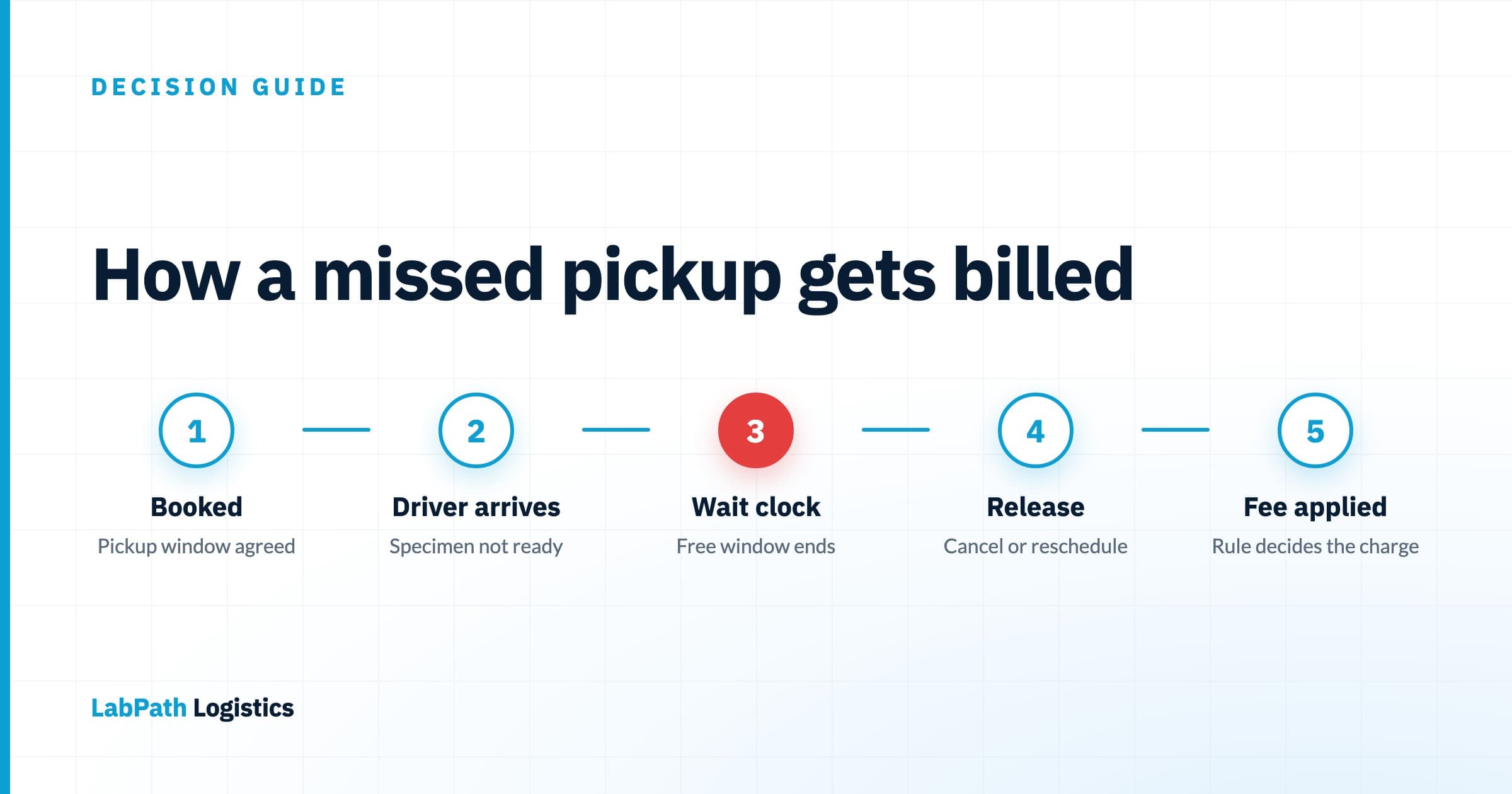
A pediatric clinic in Katy sends a medical assistant to a reference lab twice a day, once at midday and once before close. Each trip, door to door, takes most of an hour at that hour of day. On the wage line the manager's estimate is modest. Then she fills in line five and notices that the midday run is the same hour the clinic is short-staffed for walk-in sick visits, and that the afternoon run regularly makes the clinic's last patient wait.
She does not conclude that the courier wins. She concludes that the midday run is the expensive one and the afternoon run is not, and prices a courier for the midday lane only. Our pickup schedule guide shows how to decide between one sweep and several scheduled stops. The break-even gave her a decision by lane, not a blanket yes or no.
When Does Keeping a Staff Driver Make Sense?
When runs are rare, the lab is close, a clinical backup exists, and your records are already clean. A clinic with two pickups a week to a lab two miles away may rightly keep driving. The break-even should say so, and if it does, believe it. The point of the exercise is not to buy a courier. It is to stop deciding on the one line that was never the whole cost.
The broader in-house versus courier guide covers fleet-scale questions. If your sheet points toward a courier, do not commit on the first quote: our 14-day pilot guide tests one lane before you sign, and our backup plan guide covers what to require when the assigned driver is out.
How Do You Compare the Courier Quote to Your Sheet?
Compare like with like. Price the same lane at the same pickup window, and read the quote for accessorials such as wait time and redelivery, which our invoice audit guide explains line by line. Our nonbinding estimator prices a lane without signup, so you can drop the number into line seven of your own sheet, the one that says "courier annual cost."
LabPath Logistics is in early access for Greater Houston. Our booking-to-receiver-attestation workflow, including package QR scans, append-only custody events, and receiver signature, is verified locally; production dispatch, GPS, and temperature telemetry are not live yet, and the booking model has no patient fields, by design. See our platform preview and privacy engineering notes for exactly what is verified. Estimates from our public card are not booking quotes.
Frequently Asked Questions
Is it cheaper to use a medical courier or have staff drive specimens?
On the wage line alone, staff driving is often cheaper per trip. Once you add the benefits load on the employee's time, the cost of the work not done while they are out, and the custody record a courier provides, the answer depends on your volume, distance, and staffing. Run a break-even with your own numbers rather than relying on a generic comparison.
How do I calculate the true cost of a staff member driving specimens?
Multiply runs per week by door-to-door minutes, convert to hours, and apply a loaded hourly rate: the wage divided by the wage share of total compensation, which BLS put at 70.0 percent for private industry in June 2026. Add mileage and wear, then add the cost of work displaced during the trip and of any missing custody record.
How many pickups a week justify hiring a medical courier?
There is no universal threshold, because the answer depends on distance, pickup hour, and what the driver would otherwise be doing. A clinic with a few short runs a week may reasonably drive. A clinic with daily runs at busy hours, or runs that pull clinical staff off the floor, usually finds the break-even tips toward a courier on at least one lane.
Can I price a courier for just one lane or pickup window?
Yes. Many clinics find that one run, often the midday or end-of-day pickup, carries most of the hidden cost. Price that lane on its own, then run a short pilot before expanding. A lane-by-lane decision avoids committing to a full schedule on the strength of a single quote.