Blood Culture Transport in Houston: Courier or Incubator?
October 21, 2026 · By LabPath Logistics Editorial Team, Medical Logistics Desk
Quick Answer
Blood culture bottles should travel at room temperature, never refrigerated, and reach an incubator as soon as possible, with two hours the common target. The metric to manage is collection-to-incubation time at each draw site. If the gap is driven by pickup schedules, fix the courier lane. If it is driven by after-hours draws, consider a satellite incubator.
Most Houston facilities measure blood culture transport the wrong way. They track when the courier picked up and when the lab signed for the bag, and both numbers look fine. The bottle does not care about either. An inoculated blood culture bottle is a growing culture from the moment it is drawn, and the only clock that changes a sepsis result is the one that runs from the draw to the incubator. That clock usually hides hours nobody is logging: the bench wait before the next pickup sweep, the overnight hold at a freestanding ER, the accessioning queue at a core lab.
This guide gives you a one-page method, the Incubation Gap Audit, for finding those hours at each draw site. Then it walks the decision that follows: tighten the courier lane, install a satellite incubator, or do both.
What Is the Transport Rule for Blood Culture Bottles?
The IDSA and ASM guide to microbiology laboratory utilization states the rule plainly: inoculated culture vials should be transported to the laboratory as soon as possible at room temperature, and blood should never be refrigerated before incubation. Where the guide lists a number, in its meningitis workup table, it gives blood culture bottles two hours at room temperature. Lab handbooks across the country repeat the same target, and the manufacturer's instructions for your bottle system govern what happens when a delay is unavoidable.
Two hours is a target, not a rejection threshold. Organisms usually survive in an inoculated bottle that is not incubated immediately, which is exactly why the delay gets tolerated. The cost is not a lost culture. The cost is a later answer, and in sepsis a later answer is the whole problem.
Why Does the Collection-to-Incubation Gap Matter?
3.94 h vs 9.49 to 18.89 h
mean wait before incubation for bottles drawn inside city limits vs at outlying client sites, across 69,604 bottles in a consolidated lab network (Scientific Reports, 2022)
That 69,604-bottle analysis found what consolidated networks everywhere find: distance from the core lab sets the pre-incubation wait, and the wait is measured in hours, not minutes. Bottles that waited longer flagged faster once loaded, because the organisms had been growing all along, but the total time from draw to detection still rose. The same authors note that recovery falls off mainly after delays beyond 24 hours at room temperature, so the practical damage from a long bench hold is a slow result rather than a false negative.
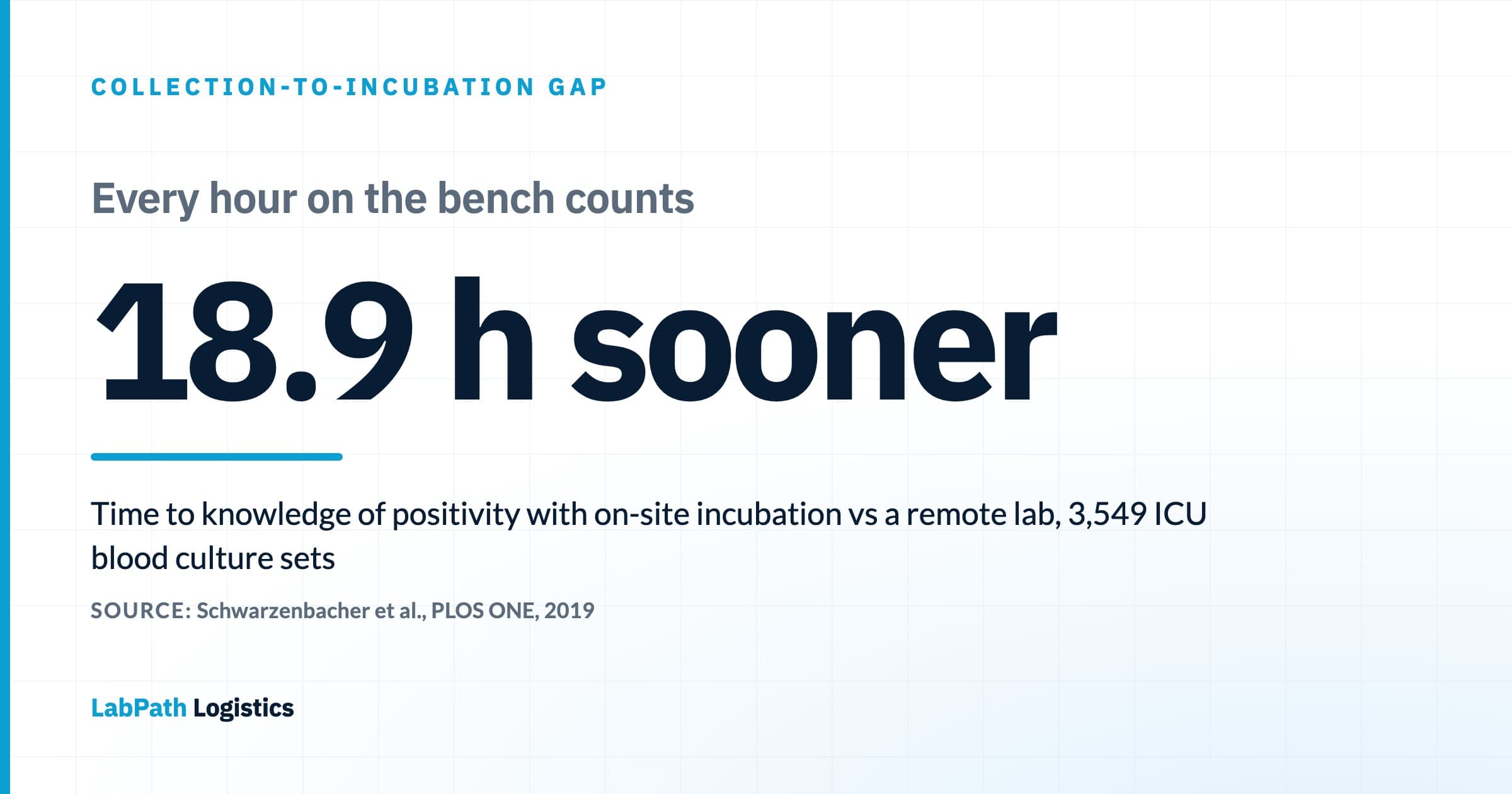
The upside of closing the gap is measurable. A single-center ICU study of 3,549 blood culture sets published in PLOS ONE compared bottles sent to a remote laboratory with bottles incubated on the unit immediately. Time to knowledge of positivity fell from 46.9 hours to 28.0 hours, and time to the final microbiological result fell from 61.4 to 42.1 hours, with the largest gains during the laboratory's off-hours. An emergency-department study in Italy that placed a continuously monitoring incubator in the ED reached the same conclusion from the other direction: the turnaround gain came mostly from eliminating transport time, not from faster processing.
The Incubation Gap Audit
You cannot choose between a courier fix and an incubator until you know where your hours go. The audit takes two weeks of data your systems already hold.
- Pull, for every blood culture set drawn at the site, the collection time from the order and the load time from the blood culture instrument. Ignore courier pickup and lab receipt for now.
- Compute the gap per set and record the median, the 90th percentile, and the share of sets exceeding 2, 4, and 12 hours.
- Split the sets by draw hour: business hours, evenings, and overnight or weekend. The split tells you whether your problem is a schedule or a building that is dark.
- For the business-hours sets, subtract the actual drive time between the site and the lab from the gap. What remains is bench wait plus accessioning queue, and that is the courier-fixable portion.
- Count sets per day. Satellite incubators are justified by volume and after-hours share; courier lanes are justified by bench wait during hours when someone could have picked up.
The Incubation Gap Audit: save and send to your lab director
Per draw site, over 14 days: (1) median and 90th-percentile draw-to-load gap; (2) share of sets over 2 h, 4 h, and 12 h; (3) the same figures split into business hours, evenings, and overnight or weekend; (4) business-hours gap minus actual drive time, which is your bench wait; (5) sets per day. Rule of thumb: a large bench wait during staffed hours is a courier problem. A large overnight share at meaningful volume is an incubator problem. Most sites have some of both.
A Houston Scenario: Same Drug, Two Very Different Clocks
Picture two sites feeding one Houston health system's core lab near the Texas Medical Center. The first is a hospital ED three miles away. Bottles ride the hourly shuttle, hit accessioning inside an hour, and load with a median gap of about 90 minutes. The second is a freestanding ER on the Grand Parkway west of Katy. A nurse draws two sets at 9 p.m. The next courier sweep is at 6 a.m., the bag reaches the core lab after rush hour, and the bottles load around 8:30 a.m. That is an eleven-hour gap, and the drive accounted for forty minutes of it.
The two sites are not one problem. The hospital ED needs nothing. The freestanding ER has an overnight problem that no daytime courier schedule can touch, and a daytime problem that a timed pickup lane fixes cheaply. This pattern is common across Greater Houston because Texas has so many outlying draw sites: Texas A&M researchers counted 338 freestanding emergency departments in the state as of May 2023, handling nearly a quarter of all emergency department visits. Each one is a blood culture origin with its own clock. Our guides to freestanding ER send-out logistics and urgent care lab courier gaps cover the broader send-out picture for these sites.
Courier Lane or Satellite Incubator: How Do You Decide?
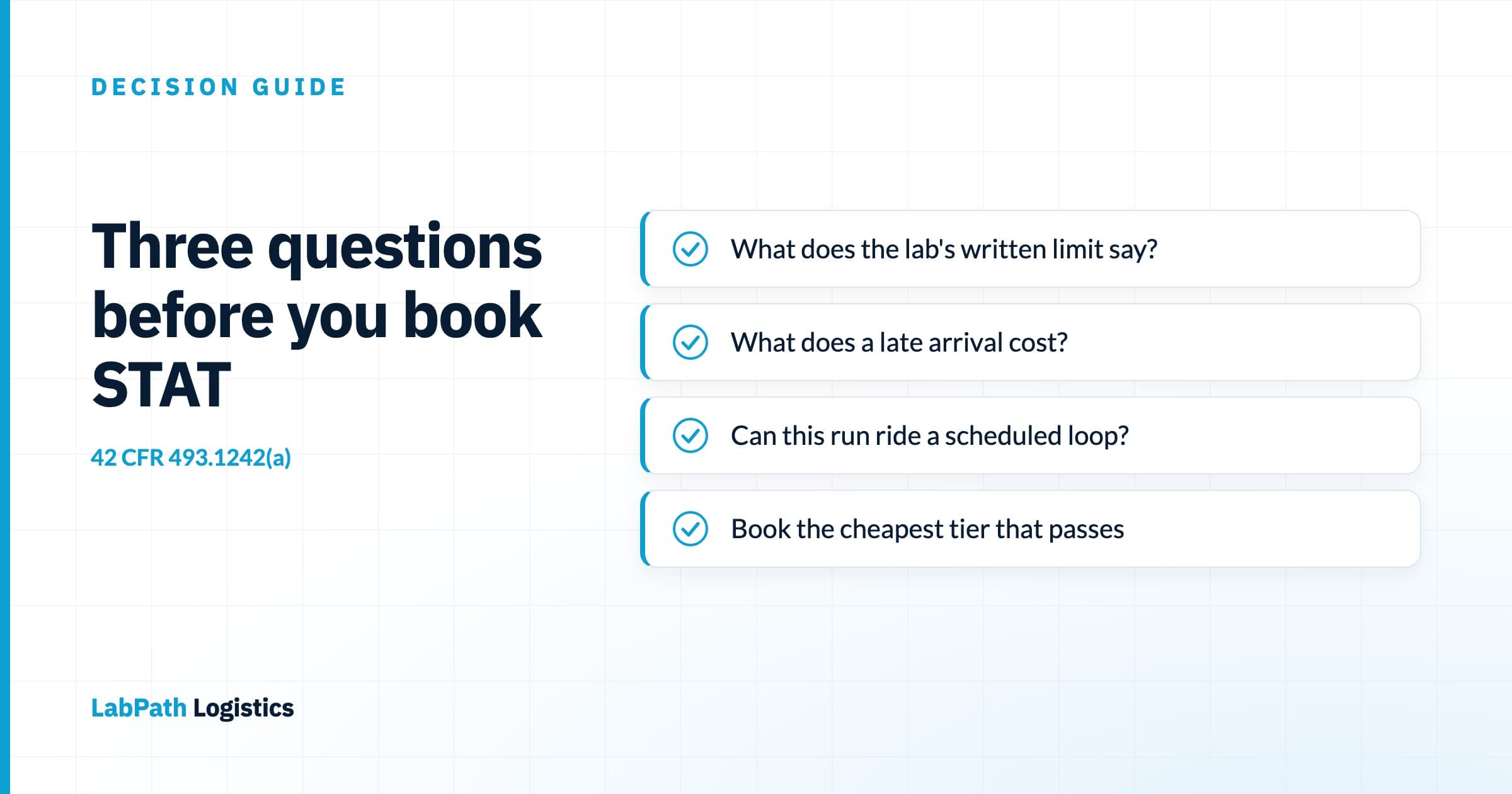
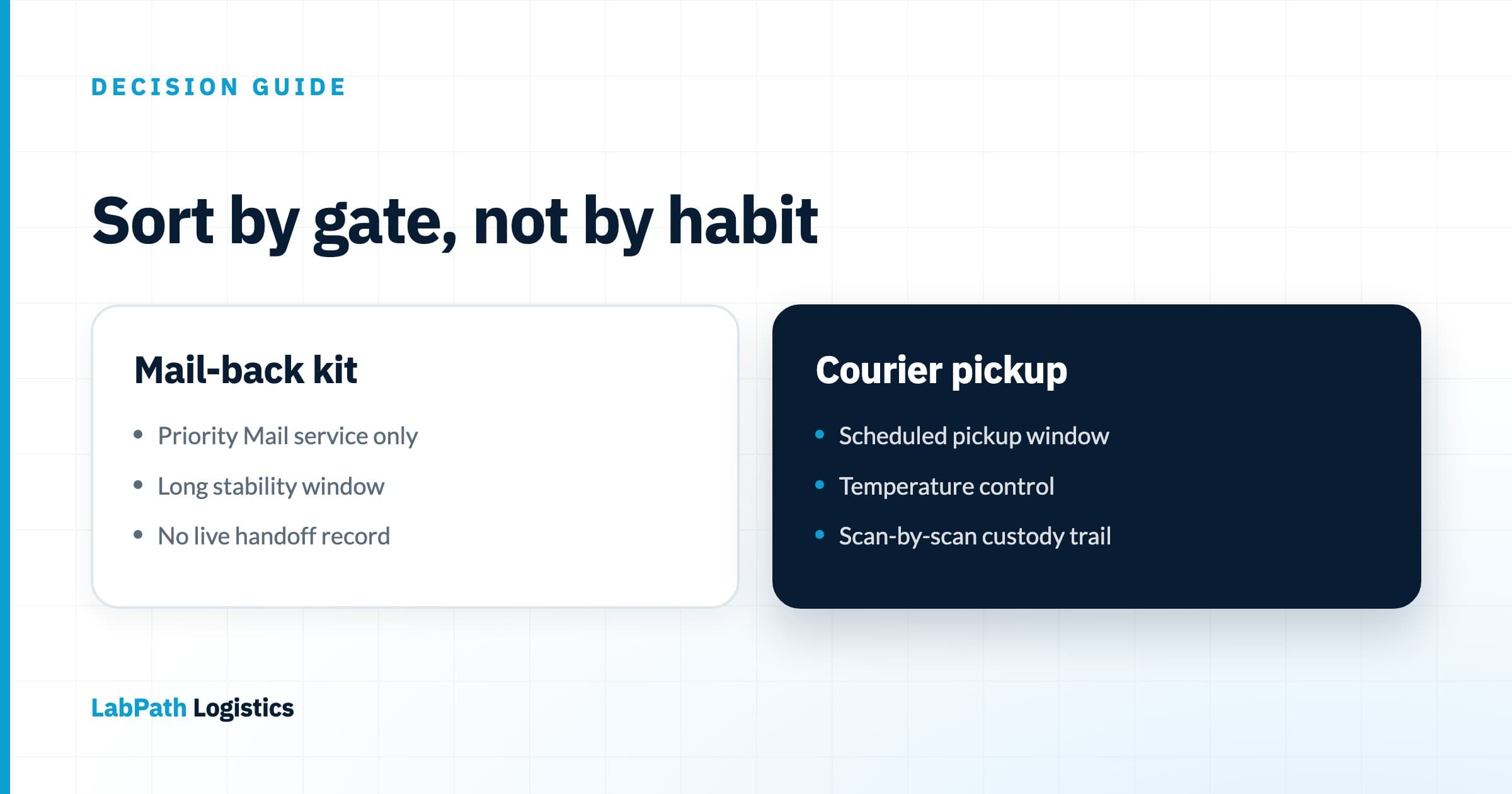
A timed courier lane is the right fix when the audit shows bench wait during staffed hours. Replace the once-a-day sweep with pickups timed to the draw pattern, or add an on-demand call for blood cultures specifically, and the business-hours gap collapses toward drive time. The structure is the same one described in our post on one sweep versus timed stops, with the bottle's two-hour target as the design constraint. Room-temperature carry is non-negotiable, which means bottles never share a cooler with refrigerated chemistry, a point our microbiology transport guide treats in detail.
A satellite incubator is the right fix when the audit shows a large after-hours share at a volume that justifies the instrument, its CLIA scope, quality control, and someone trained to load and acknowledge alarms. The evidence favoring satellite incubation comes largely from ICUs and EDs with substantial volume. One ICU study of 204 culture sets cut collection-to-incubation from 3.51 to 1.65 hours yet found no statistically significant change in time to positivity, partly because the lab was in the same building and the sample was small. A satellite instrument closes a gap you actually have. It does not help a site whose real gap is a daytime bench wait.
Most multi-site systems land on both: a satellite incubator at the one or two high-volume outlying sites with heavy overnight draws, and a timed courier lane everywhere else, with after-hours coverage priced explicitly rather than assumed. Positive bottles from a satellite instrument still have to travel to the core lab for identification and susceptibility, so the incubator never removes the courier lane. It changes what the lane carries and how urgently.
What Does a Timed Blood Culture Lane Cost?
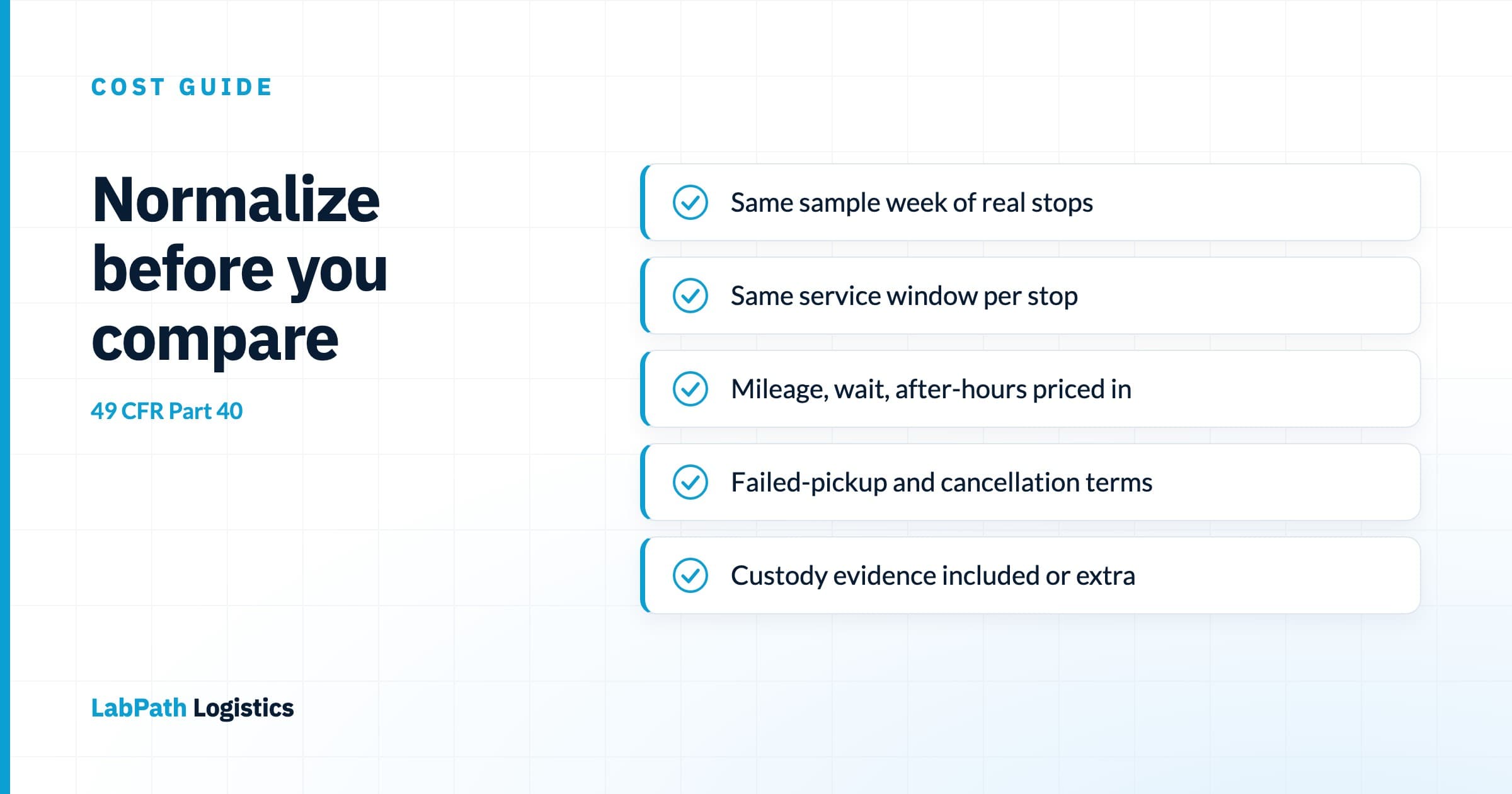
Price it against the audit, not against your current invoice. If your business-hours bench wait is six hours, the comparison is between a scheduled stop timed to the draw pattern and the clinical cost of a six-hour-later Gram stain. Our nonbinding estimator prices a Houston lane by service level and distance without signup, and the services page explains the difference between shared scheduled stops, dedicated routes, and on-demand runs so you can match the lane to the gap. If you are standing up a timed lane for the first time, run it as a 14-day pilot on the single worst site from your audit and re-measure the gap at the end.
LabPath Logistics is in early access for Greater Houston. Our booking-to-receiver-attestation workflow, with package QR scans, append-only custody events, and receiver attestation and signature, is verified locally; production dispatch, GPS, and temperature telemetry are not live yet. The booking model has no patient fields, by design, which matters when every bottle in the bag is tied to a named sepsis workup. See the platform preview and privacy engineering notes for exactly what is verified today.
Frequently Asked Questions
How long can blood culture bottles sit before incubation?
The common target is incubation within two hours of collection, and the IDSA and ASM guidance is to transport inoculated bottles to the laboratory as soon as possible at room temperature. Bottles that wait longer usually still grow, but the result arrives later. Published data suggest organism recovery falls off mainly after delays beyond 24 hours at room temperature, so the main cost of a long wait is a slower sepsis answer rather than a lost culture. Follow your bottle manufacturer's instructions for unavoidable delays.
Should blood culture bottles be refrigerated during transport?
No. Inoculated blood culture bottles should be held and transported at room temperature and never refrigerated or frozen before incubation. Refrigeration can suppress or kill the organisms the culture exists to detect, and many laboratories list refrigerated or frozen bottles as unacceptable specimens. In a courier run, bottles need a segregated ambient compartment so they never ride in the same cooler as refrigerated chemistry tubes.
What is a satellite blood culture incubator and when is it worth it?
A satellite blood culture incubator is a continuously monitoring instrument placed at the draw site, such as an ICU, ED, or freestanding ER, so bottles load immediately instead of traveling to the core lab first. It is worth considering when a site has meaningful blood culture volume and a large share of draws during hours when no courier or lab shift can move bottles promptly. Positive bottles still travel to the core lab for identification and susceptibility testing, so the instrument complements a courier lane rather than replacing it.
Can a medical courier carry blood cultures with refrigerated specimens on the same run?
Yes, if the vehicle and the handling protocol keep them physically separate. Blood culture bottles ride in an ambient compartment and refrigerated specimens ride in a validated cooler, with the driver trained on which container is which. The contract should state the room-temperature carry requirement for blood cultures and the target time from pickup to lab handoff, and the facility should verify the collection-to-incubation gap after the lane starts rather than assuming the schedule delivers it.