Ammonia Specimen Transport on Ice in Houston
September 29, 2026 · By LabPath Logistics Editorial Team, Medical Logistics Desk
Quick Answer
Plasma ammonia must go on ice immediately after collection, and most laboratories require plasma to be separated from cells within 15 minutes. Because ammonia keeps rising in the tube, a courier cannot treat it like a routine pickup: the specimen needs a dedicated STAT run, a real ice slurry rather than a warm gel pack, and a recorded draw time on the tube and the requisition. When the window is missed, the lab rejects the result and the patient is redrawn.
Most specimens tolerate a delay. Ammonia does not. Once blood is drawn, cells keep producing ammonia in the tube, so the number the lab reports can climb simply because the courier was late. Ammonia specimen transport on ice is one of the few pickups where a 20-minute delay changes the result, and that makes it a different kind of job from the routine route.
This guide is for Houston clinic administrators, hospital outreach coordinators, and lab managers who send ammonia and other on-ice tests to a reference lab or a Texas Medical Center core lab. It covers what the lab requires, where the courier leg goes wrong, and how to build a pickup process that protects the result. It is operations guidance only, not clinical advice.
Why Ammonia Is Different From Routine Chemistry
Laboratories are explicit about the problem. Rady Children's Health notes that ammonia levels increase as a specimen sits before testing, and asks that collected specimens go on ice immediately and reach the lab quickly. The falsely high result is not a lab error; it is a handling artifact created before the specimen ever arrives.
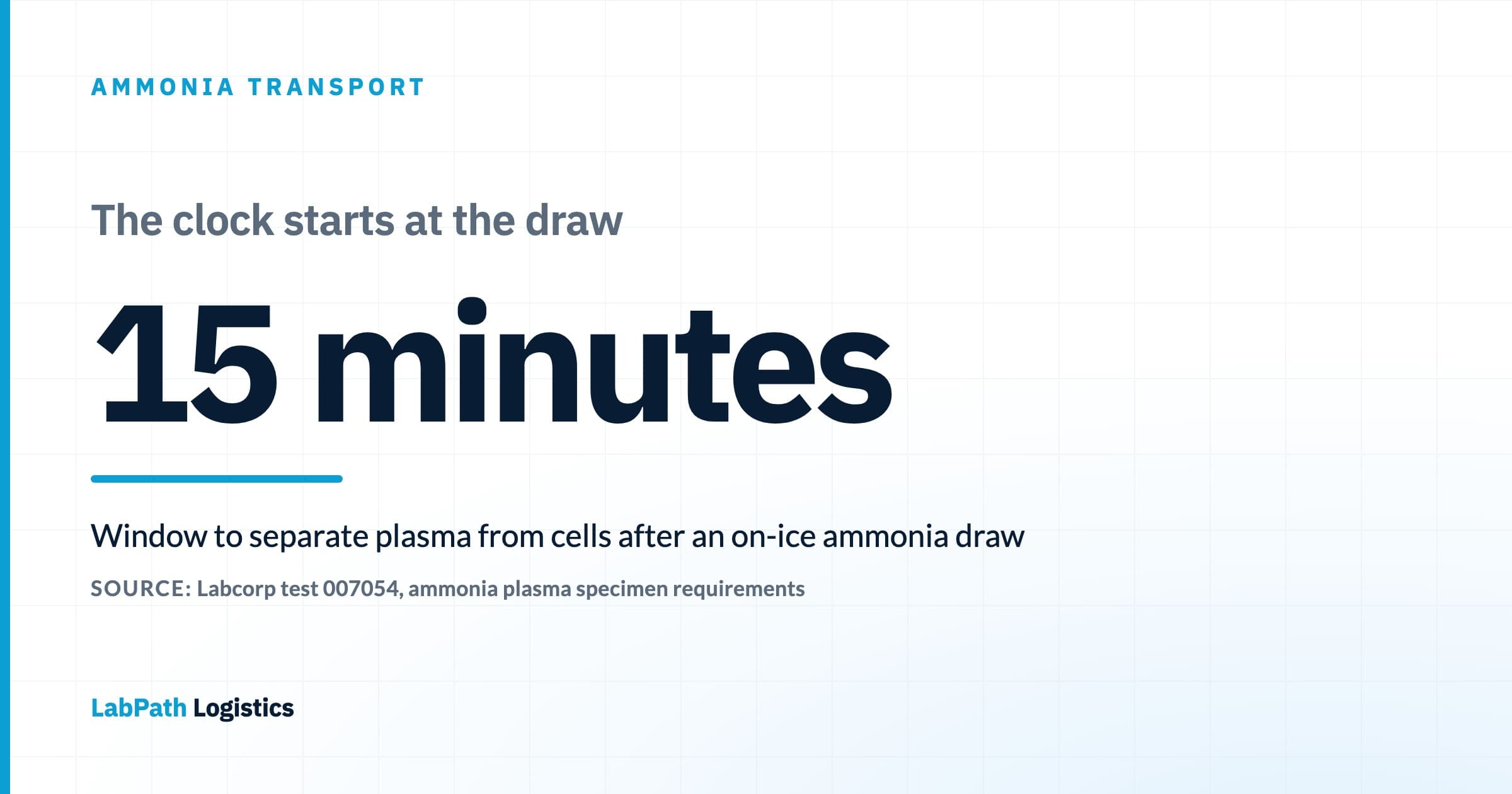
15 minutes
Labcorp requires the specimen to be placed on ice immediately and plasma separated from cells within 15 minutes of collection
Labcorp's stability data shows how narrow the margin is: unstable at room temperature, two hours refrigerated, and three days frozen. Those figures apply to plasma that has already been separated, which is why the first 15 minutes matter most. Your reference lab's test directory is the authority for your specific assay, and tube types differ between labs (EDTA at Labcorp, lithium heparin preferred at Rady with EDTA acceptable), so always check the directory entry before building a workflow.
Where the Courier Leg Fails
- The specimen is drawn, then waits in the clinic for the next scheduled route stop.
- A gel pack that has been sitting at room temperature is used instead of ice, so the tube never actually cools.
- The tube is not labeled with the draw time, so the lab cannot judge whether the window was met.
- The specimen rides with routine tubes on a multi-stop route instead of a direct run.
- The receiving dock is not expecting it, and the tube waits in a queue before reaching the bench.
Each of these is fixable at the clinic level. None of them require new equipment, only a defined process and a courier that treats the order as time-critical.
"On Ice" Means an Ice Slurry, Not a Cold Pack
Labs that specify on-ice handling mean the tube is in contact with ice and water in a cup or insulated container. A frozen gel pack designed for the 2–8 °C refrigerated range does not cool a small tube quickly, and in a Houston summer trunk it stops helping within minutes. Confirm with your lab whether they want ice slurry, and prepare it at the point of collection rather than expecting the driver to do it. Our guide to specimen transport temperature explains how the ranges differ, and our post on Houston heat and specimen integrity covers what a hot vehicle does to packaging.
Refrigerated is not on ice
Do not substitute a 2–8 °C shipment for an on-ice specimen unless the lab confirms it in writing. The two handling requirements are different, and a specimen received refrigerated when ice was required can be rejected.
A Houston Scenario: The Outreach Clinic and the Core Lab
Picture a hepatology clinic in Katy that draws an ammonia at 10:05 a.m. and sends it to a core lab near the Texas Medical Center. The next scheduled pickup is at 11:00. On a normal route, the tube arrives after noon, well outside a 15-minute separation window, and the lab cancels the test and requests a redraw. The patient returns, the clinic loses half a day, and the physician still has no result.
The fix is not a faster van. It is a process: the nurse calls the courier before the draw, the tube goes into an ice cup at the bedside with the draw time written on the label, and a driver is already en route so pickup happens within minutes. The core lab is told a specimen is inbound so it can be centrifuged on arrival. Our STAT specimen delivery checklist walks through the same call-ahead sequence.
A Clinic Process for On-Ice Specimens
- Pre-book the pickup before the draw, not after, and tell the courier the specimen is on ice and time-critical.
- Prepare the ice slurry in advance and place the tube in it immediately after collection.
- Write the draw time on the tube and the requisition, as labs such as Labcorp require.
- Fill the tube as the lab directs and keep it stoppered, following the test directory.
- Send the specimen as a direct run, not a stop on a multi-drop route.
- Notify the receiving lab that the specimen is inbound so it is processed on arrival.
Other Tests With Similar Handling
Ammonia is the best-known example, but it is not the only test with a short, strict window. Blood gas specimens have their own rules, covered in our guide to arterial blood gas specimen transport, and coagulation testing has its own time limits, covered in coagulation specimen transport. Build one list of your time-critical tests from your reference lab's directory, and flag them in your ordering system so the courier is called automatically.
Under CLIA, 42 CFR 493.1242 requires laboratories to maintain written policies for specimen handling and transportation conditions. Your lab's policy is the standard your courier process has to meet, and rejections are the feedback loop. Our overview of specimen rejection causes shows how to track them.
Frequently Asked Questions
How long can an ammonia specimen sit before it is tested?
Labcorp requires the specimen to be placed on ice immediately and the plasma separated from cells within 15 minutes of collection. Rady Children's Health likewise specifies no more than 15 minutes from collection to centrifugation. Your reference lab's directory sets the rule for your assay.
Why does ammonia have to be transported on ice?
Ammonia levels increase as a specimen sits before testing, which can produce a falsely high result. Ice slows that change, but it does not stop it, so the specimen must still reach the lab and be processed quickly.
Can I use a refrigerated courier for an ammonia specimen?
Only if your lab confirms it. On-ice handling and refrigerated 2–8 °C transport are different requirements, and specimens not kept on ice can be rejected. Ask the receiving lab what it accepts and document the answer.
What should the label on an ammonia tube include?
Along with standard patient identification, the draw date and time should be written on the tube and the requisition. Labs such as Labcorp require this so they can verify the specimen was processed within the allowed window.