Winter Storm Plan for Medical Couriers in Houston
October 3, 2026 · By LabPath Logistics Editorial Team, Medical Logistics Desk
Quick Answer
A Houston winter storm plan for specimen transport has to cover two failures at once: roads and power that stop routes, and freezing air that damages specimens meant to travel cool or at room temperature. Write it before December — name a freeze trigger, pre-agree which specimens move and which hold, keep refrigerated specimens off direct contact with cold packs, insulate ambient specimens against freezing, and confirm each receiving lab's weekend and outage hours.
Houston plans for heat and hurricanes every year. It plans for ice almost never, which is exactly why a hard freeze does so much damage when it arrives. A winter storm medical courier plan for Houston is cheap to write in October and nearly impossible to improvise in February, when overpasses are closed, clinics are dark, and a cooler of specimens is sitting in a car that cannot reach the lab.
This guide is for Houston lab managers, clinic administrators, pharmacy directors, and outreach teams. It covers what the February 2021 storm showed, the specimen-handling risk most facilities overlook, and a contingency plan you can agree with your courier before the first freeze warning. It is logistics guidance only, not clinical advice.
What the 2021 Freeze Showed
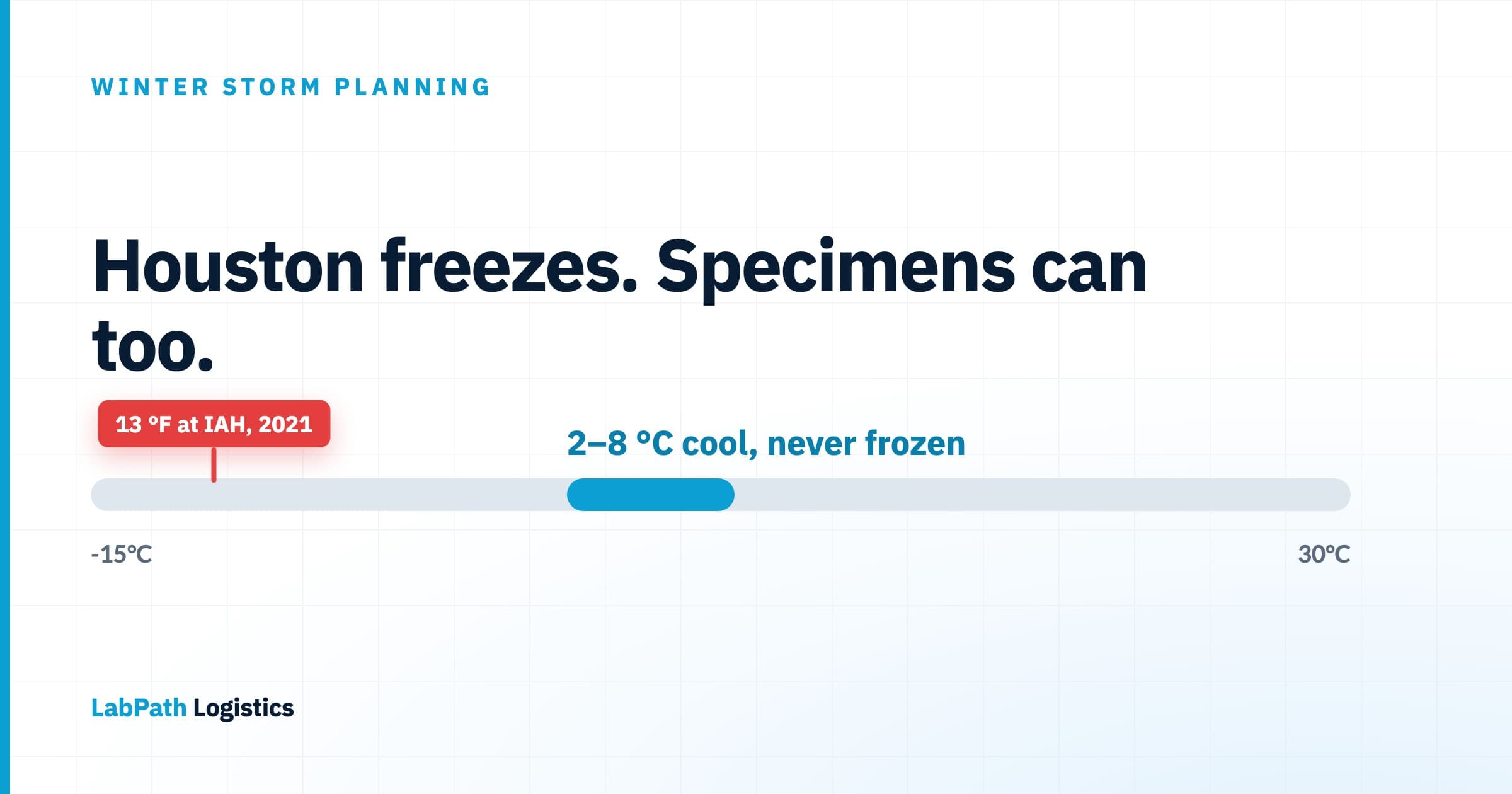
Winter Storm Uri is the reference event for Texas. The air temperature at George Bush Intercontinental Airport fell to 13 °F on the morning of February 16, 2021, and the National Weather Service's Houston office issued its first-ever Wind Chill Warning. At the same time, the state grid failed. The FERC–NERC final report describes ERCOT ordering 20,000 MW of rolling blackouts — the largest manually controlled load-shedding event in U.S. history — and more than 4.5 million people in Texas losing power, some for as long as four days.
4.5 million
People in Texas who lost power during the February 2021 freeze, some for up to four days (FERC–NERC final report)
The human cost was severe. The Texas Department of State Health Services put the final death toll at 246 across 77 counties, with about 9% of deaths caused by motor vehicle accidents. For a courier operation, those two facts frame the problem: the roads were dangerous, and many of the facilities on both ends of a route had no power, no heat, and in some cases no water.
Two Failures at Once: Routes and Specimens
Most winter planning stops at the first failure — the courier cannot drive. The second failure is quieter. In a Houston freeze, the outside air is colder than any refrigerator, so the risk flips: specimens meant to travel cool or at room temperature can freeze in a car, a lockbox, or an unheated loading dock.
The Texas DSHS South Texas Laboratory makes the point plainly in its hematology requirements: whole blood for a CBC is kept cool but not frozen, packed with absorbent paper so tubes do not touch the ice packs, because direct contact with ice packs causes hemolysis and rejection. It also warns never to ship those tubes on dry ice. A hemolyzed tube is a redraw, and in a storm week the patient may not be able to come back.
Lockboxes cut both ways
A lockbox that protects specimens from August heat offers little protection from a hard freeze. If your clinic uses an outdoor box, decide now whether it is closed during freeze warnings. Our [specimen lockbox guide](/blog/specimen-lockbox-houston) covers placement and pickup rules.
A Houston Scenario: The Tuesday Freeze
Picture a Katy-area clinic on a Tuesday morning after an overnight freeze. Ice has closed several elevated ramps on I-10 and the Grand Parkway, the clinic is running on reduced staff, and its reference lab in the Medical Center has power but a skeleton receiving crew. The clinic still has refrigerated tubes from Monday afternoon and a handful of new draws.
Without a plan, everyone improvises: a staff member drives the tubes in a personal car, or the specimens wait in a refrigerator that loses power at noon. With a plan, the decision was made in October. The clinic knows its freeze trigger, which tests it will still draw, where specimens hold if the route is cancelled, which lab accepts receipts during the outage, and who makes the go or no-go call.
The Contingency Plan to Agree on Now
- Set a freeze trigger. Tie route changes to a specific signal, such as a National Weather Service freeze or winter storm warning for your county, so nobody debates it at 6 a.m.
- Rank your specimens. Agree with the receiving lab which specimens must move even in bad conditions and which can be held, postponed, or redrawn after the storm.
- Plan cold-weather packaging. Refrigerated specimens stay off direct contact with cold packs; ambient specimens ride in insulated containers so the cabin or trunk cannot freeze them.
- Confirm hold capacity. Know which refrigerator holds specimens if a route is cancelled, and what happens if that building loses power.
- Map the lab side. Get each receiving lab's outage plan, weekend receiving hours, and an alternate drop point if the primary is closed.
- Name the decision-maker. One person at the facility and one at the courier make the go or no-go call and log it.
- Pre-book recovery runs. Schedule extra pickups for the first clear day, when the backlog arrives all at once.
Much of this overlaps with storm planning you may already have. Our hurricane season courier guide covers pre-staging and communication, and our after-hours coverage guide covers the nights and weekends when storms tend to land.
Put It in the Contract, Not Just the Binder
Hospitals and many other providers already maintain emergency plans under the CMS Emergency Preparedness Rule. Your courier is part of that plan whether it is written down or not. Ask how the courier decides to suspend routes, how it notifies you, how it documents specimen temperature handling during delays, and how it prioritizes your stops when service resumes.
Then write the answers into the service agreement. A weather clause that only says delays are excused protects the courier; a clause that defines the trigger, the notification, and the recovery schedule protects your specimens. Our medical courier SLA guide shows how to define those terms, and our specimen transport temperature guide explains the refrigerated, frozen, and ambient lanes your plan has to protect.
Frequently Asked Questions
Can blood specimens freeze during a courier trip in winter?
Yes. In a hard freeze, a car, lockbox, or loading dock can drop below 0 °C. The Texas DSHS South Texas Laboratory warns that whole blood for a CBC must be kept cool but not frozen, and that direct contact with ice packs causes hemolysis and rejection. Insulated packaging protects ambient and refrigerated specimens from freezing air.
What should a medical courier do when roads are iced over in Houston?
Follow a pre-agreed plan: suspend or reroute non-urgent runs at a defined trigger, move only the specimens the lab and facility ranked as critical, hold the rest in powered refrigeration, notify both ends of each route, and schedule recovery pickups for the first safe day.
How many people lost power in the 2021 Texas freeze?
The FERC–NERC final report on the February 2021 freeze states that more than 4.5 million people in Texas lost power, some for as long as four days, after ERCOT ordered 20,000 MW of rolling blackouts.
When should a Houston facility write its winter courier plan?
Before the first freeze, ideally in October or November. Decisions about triggers, specimen priority, hold capacity, and receiving-lab hours take conversations with the lab and the courier that are hard to arrange once a storm is forecast.